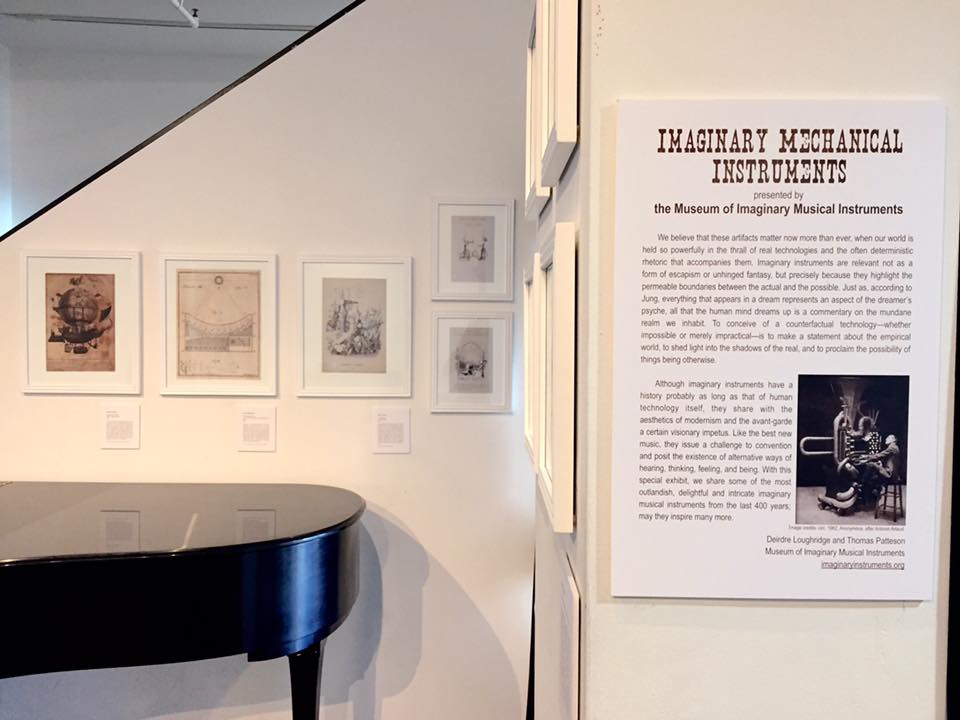
Since 2013, Thomas Patteson and I have curated the Museum of Imaginary Musical Instruments online. This year it became a book, published by Reaktion. And now, thanks to the Center for the Arts at Northeastern University, it exists through December as something you can walk through: a showcase on the third floor of Ryder Hall in Boston, home to the Department of Music.
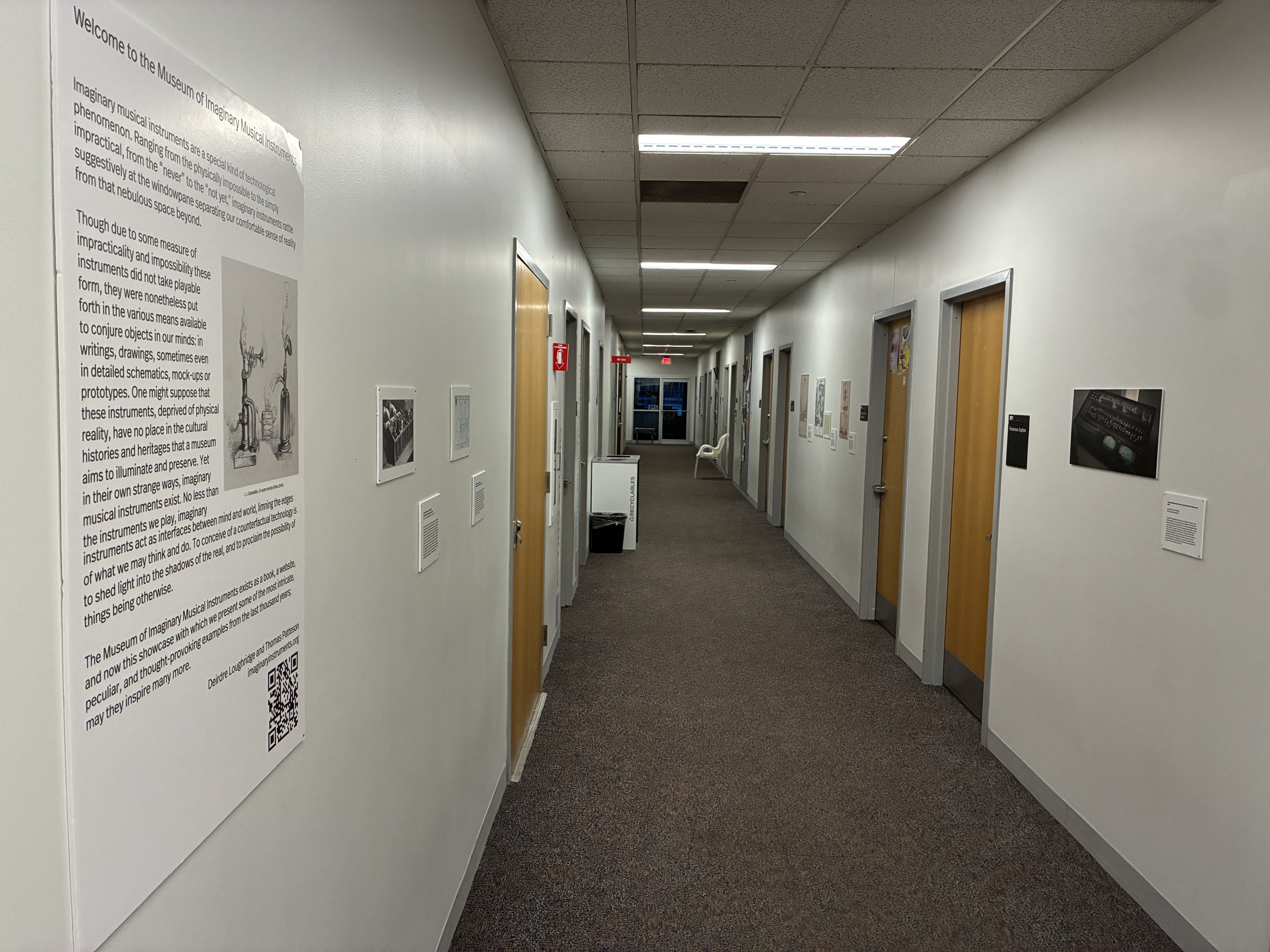
Instruments that don’t exist hang in a hallway lined with practice rooms and faculty offices. During the installation, the sound of people rehearsing drifted through the doors, real instruments being played a few feet from imaginary ones.
I love how this juxtaposition resonates with the spirit of the project. As we say on the welcome panel: imaginary instruments are, no less than the ones we play, interfaces between mind and world; they limn the edges of what we can think and do.
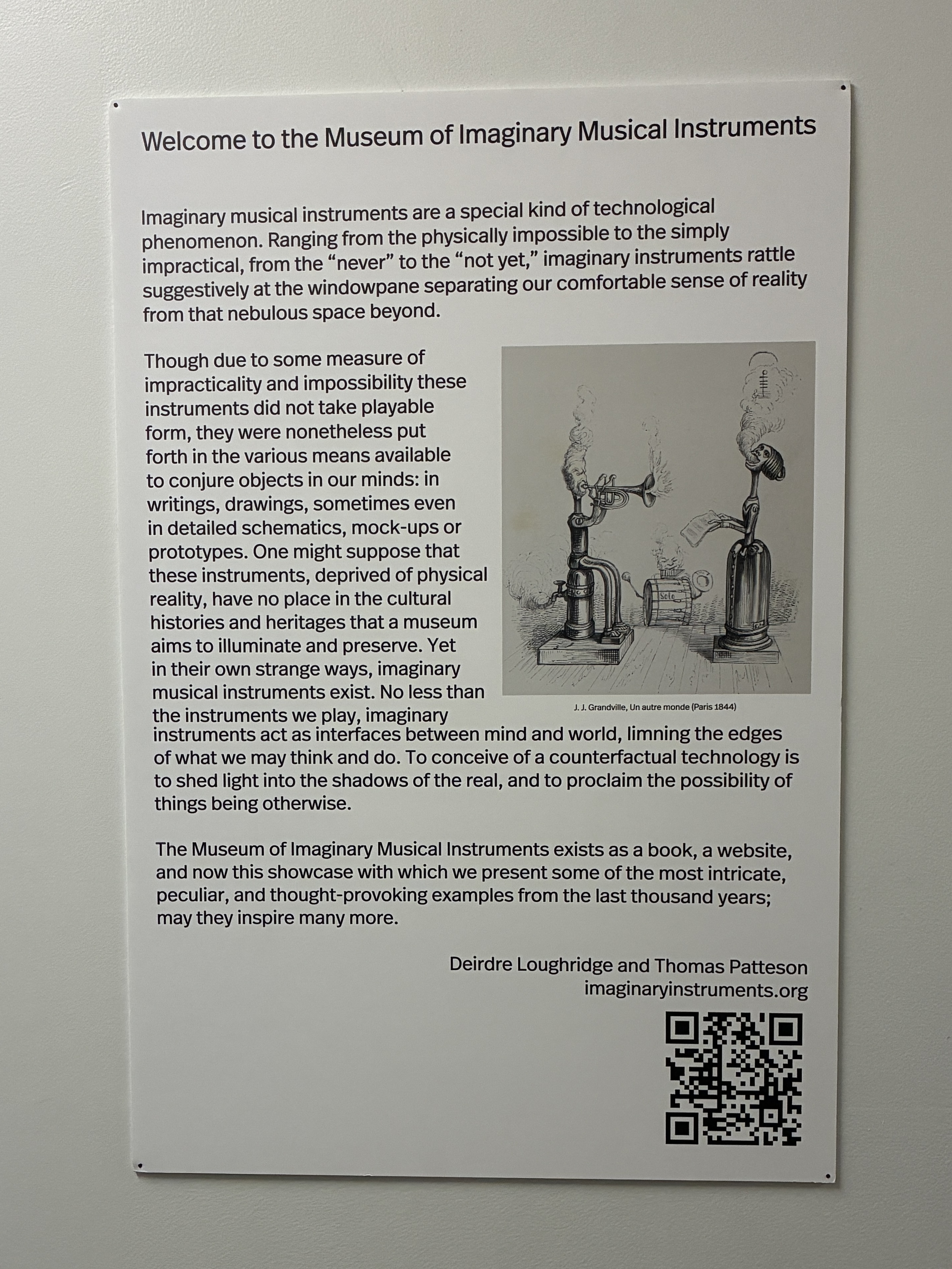
The book gathers far more instruments than any hallway could display (well, at least any practical one). The showcase offers a small sample of how imagination works with the stuff of sound and technology. Here’s a tour through it.
What may have been
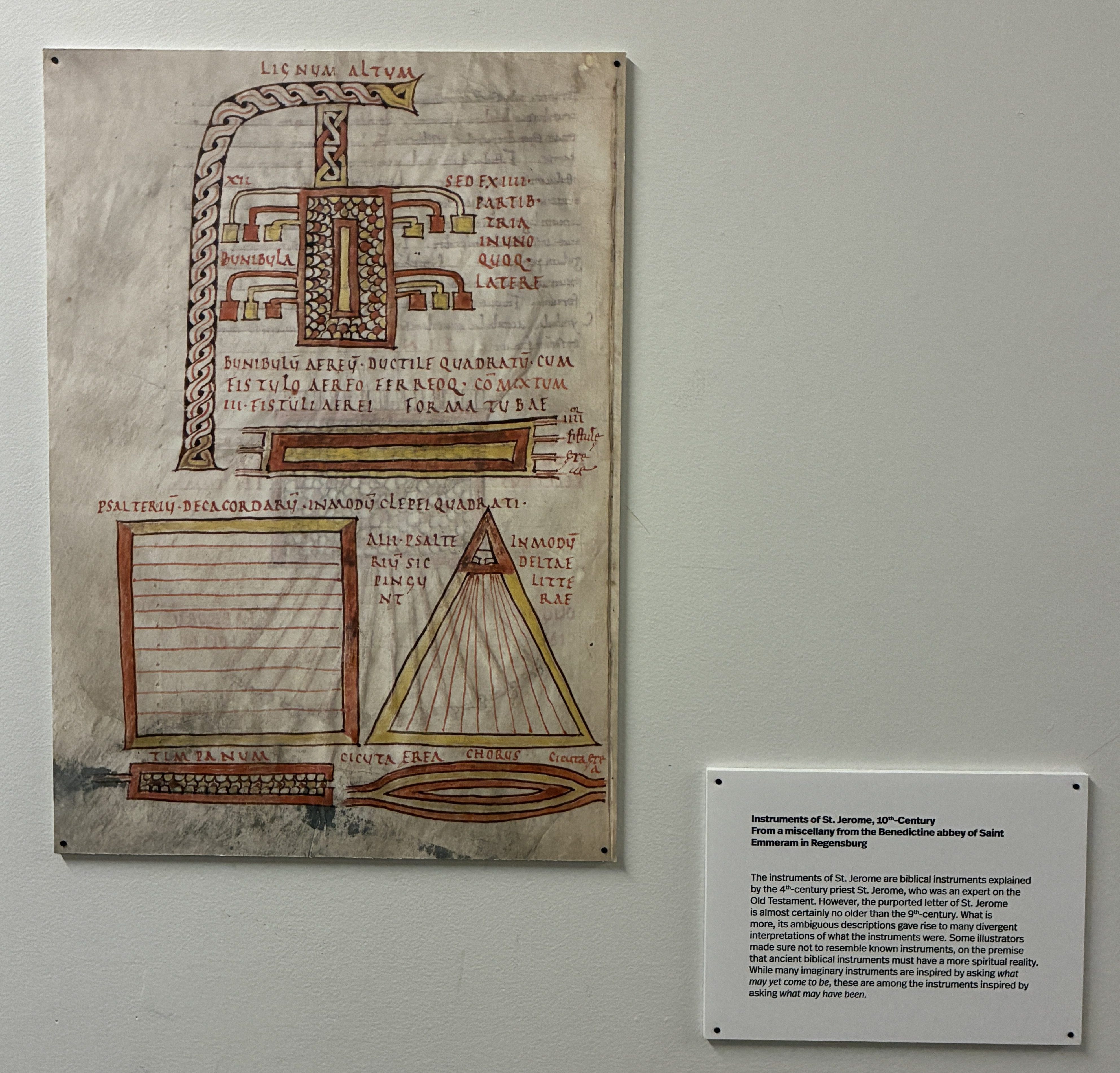
Many imaginary instruments come from asking what may yet come to be. The oldest object in the showcase comes from the opposite question. A tenth-century manuscript from the abbey of Saint Emmeram in Regensburg illustrates the “instruments of St. Jerome,” biblical instruments described in a letter attributed to Jerome but almost certainly written centuries later. Its vague descriptions invited wildly divergent drawings. Some illustrators deliberately avoided any resemblance to known instruments, on the theory that sacred ancient instruments must have had a more spiritual reality.
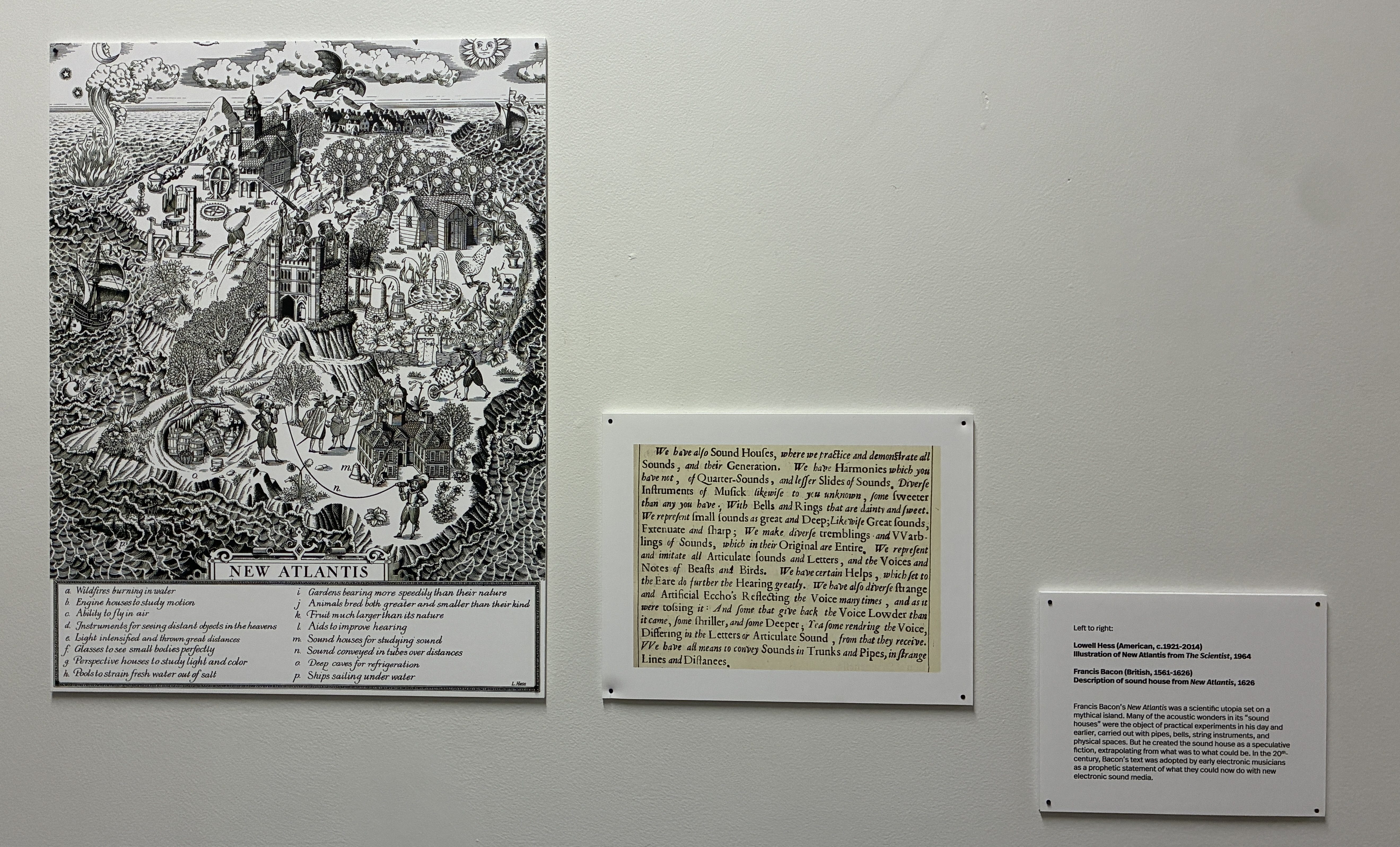
Nearby is the “sound houses” passage from Francis Bacon’s New Atlantis (1626), which describes places for producing and studying every kind of sound, alongside Lowell Hess’s 1964 illustration of Bacon’s utopian island. Three centuries after Bacon, electronic musicians adopted his text as prophecy. Daphne Oram, co-founder of the BBC Radiophonic Workshop, posted it on the studio door and then rewrote it for her own vision. Her story, including an instrument design of her own, is one of my favorites in the book.
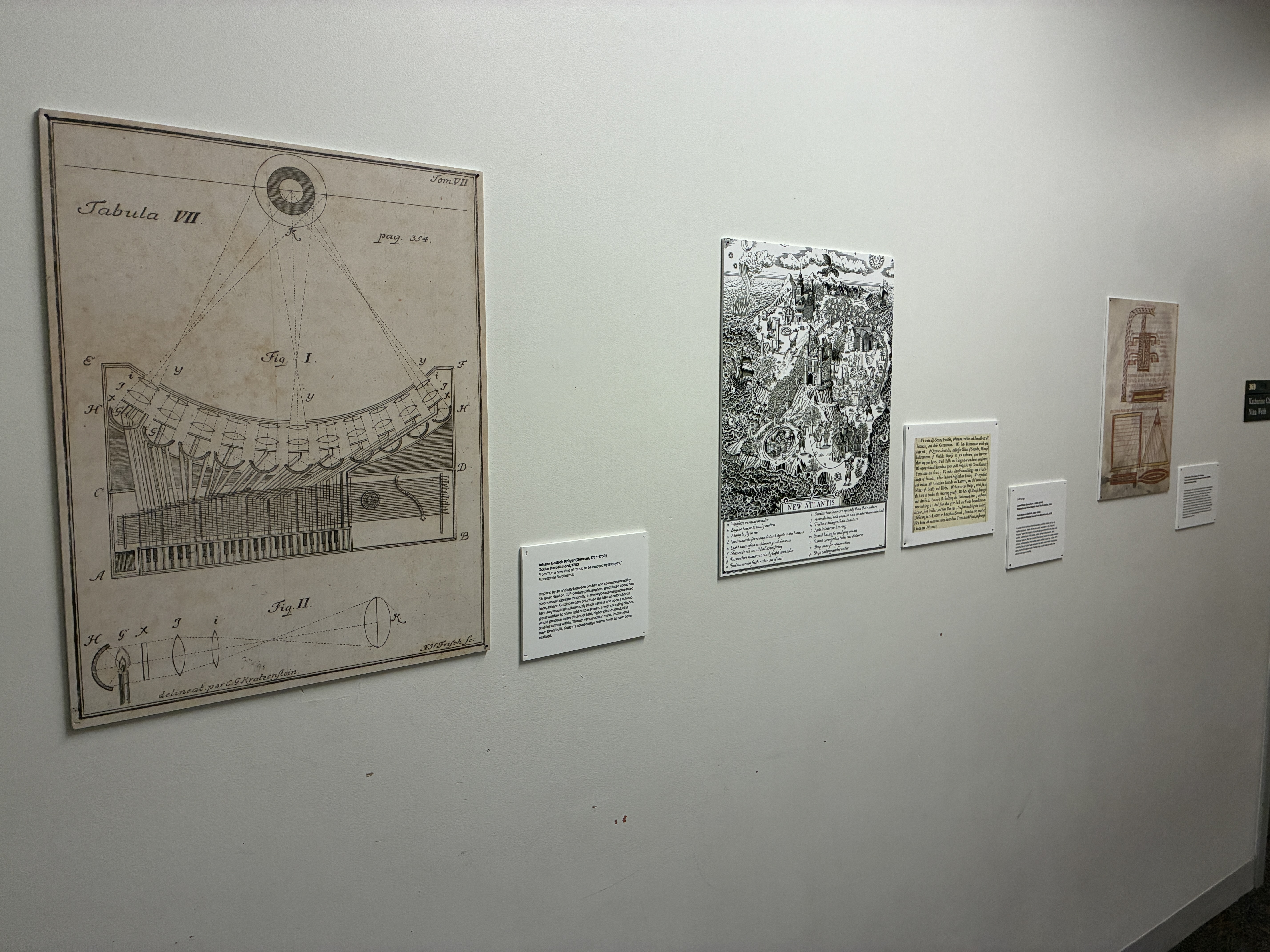
Johann Gottlob Krüger’s ocular harpsichord (1743) would have played chords of light. Each key plucked a string and opened a colored-glass window, following Newton’s analogy between pitches and colors. Other color instruments were built, but as far as we know, this one never was.
Necessary monsters
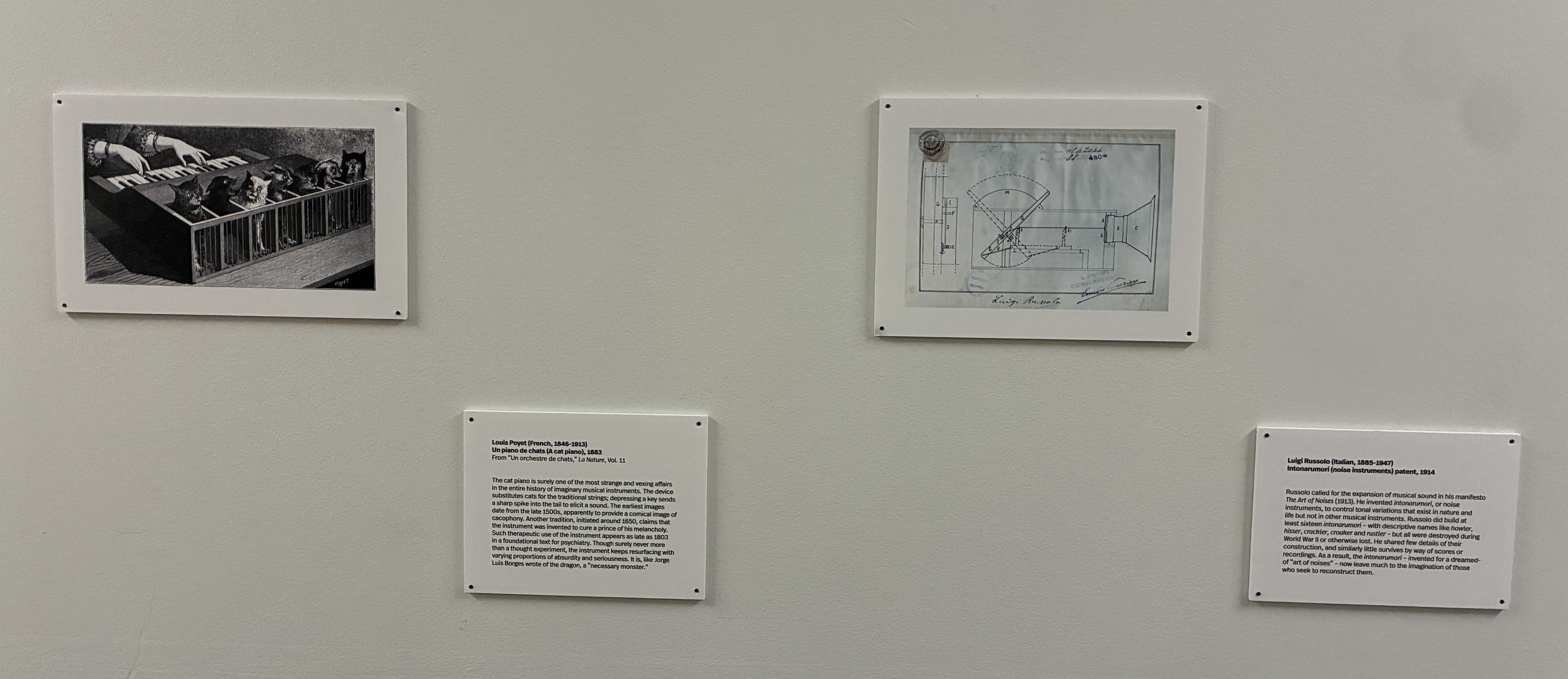
No imaginary instrument is more vexing than the cat piano, shown here in Louis Poyet’s 1883 engraving. It turns up again and again from the late 1500s onward, sometimes as a joke about cacophony and sometimes, disturbingly, as a cure for melancholy. Borges’s phrase for the dragon fits it: a “necessary monster.” Why it keeps coming back is one of the questions the book explores.
Luigi Russolo’s intonarumori went the other way. He actually built at least sixteen noise instruments, with names like the howler, the hisser, and the crackler, but all were lost, along with most of the details of how they worked. An instrument that once existed has become imaginary again, known more as an idea than an object.
Science fictions, comic and earnest
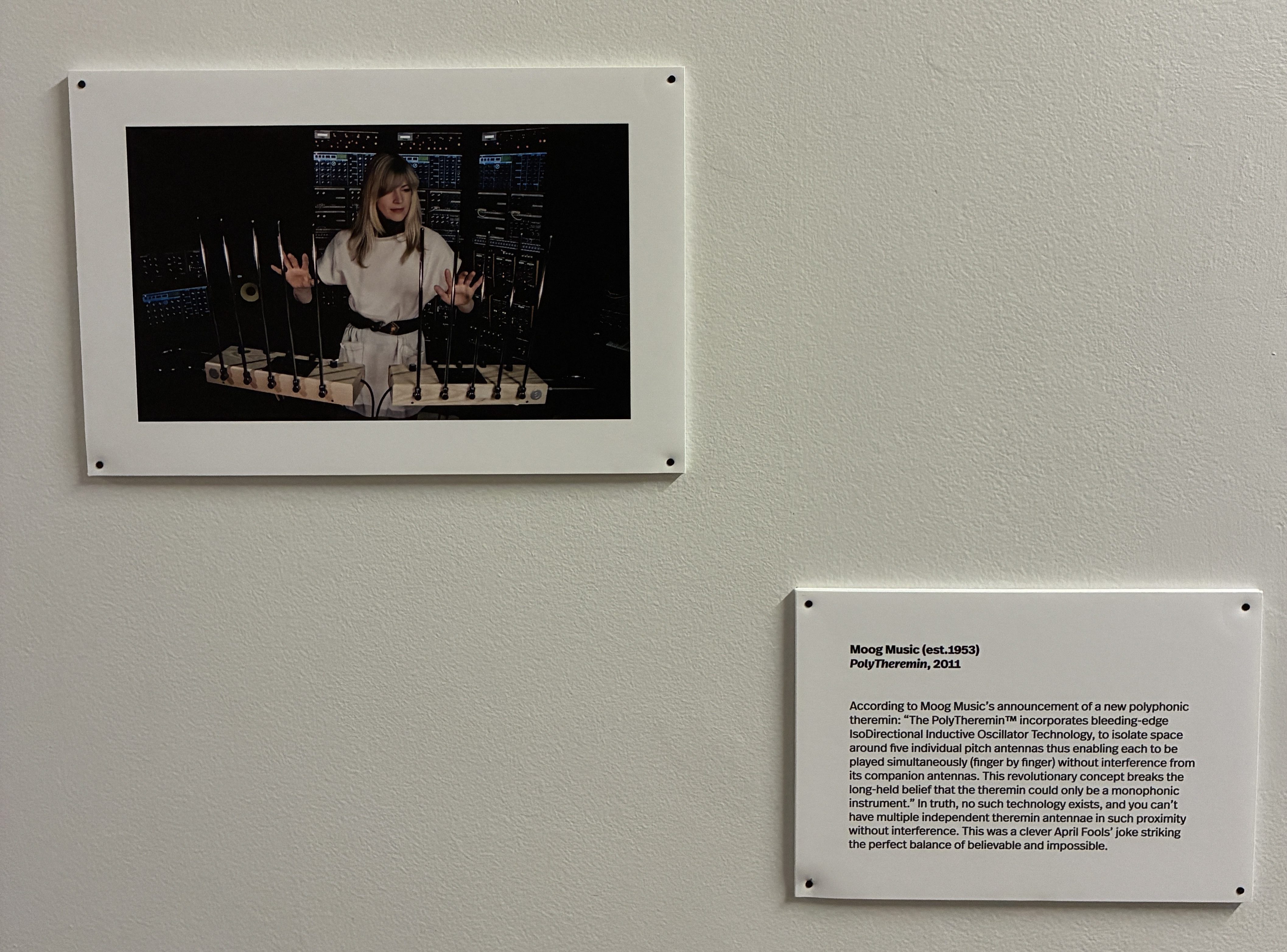
In 2011, Moog Music announced the PolyTheremin, with five antennas played finger by finger. It was an April Fools’ joke, believable and impossible in exactly the right proportions, and demonstrated by the very real thereminist Dorit Chrysler.
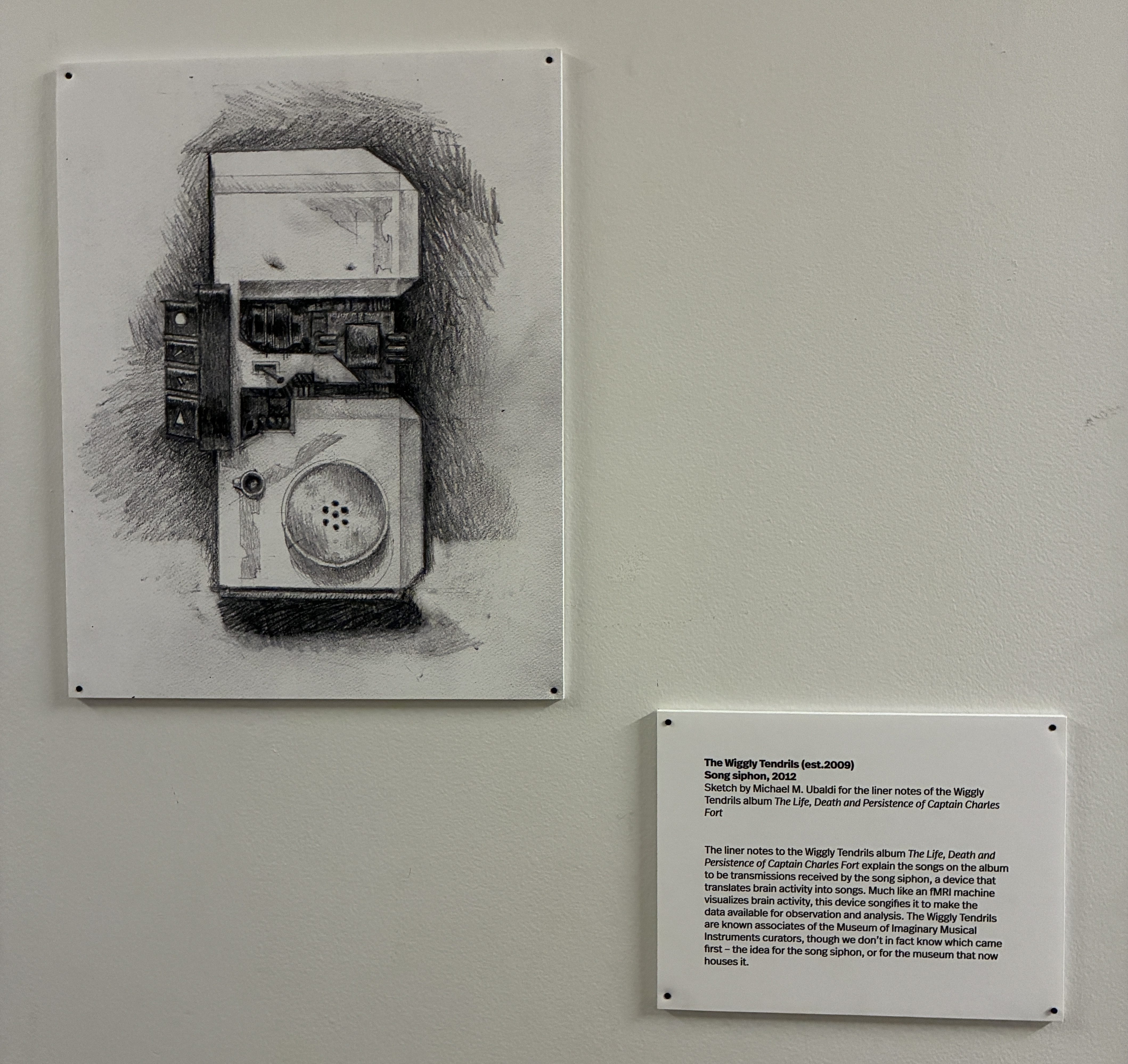
The Wiggly Tendrils’ song siphon translates brain activity into songs. It comes from the liner notes of their album The Life, Death and Persistence of Captain Charles Fort. The band are known associates of the museum’s curators, and which came first, the siphon or the museum, remains unclear. (The Wiggly Tendrils played songs from the album at our Rozzie Bound Books event in September.)
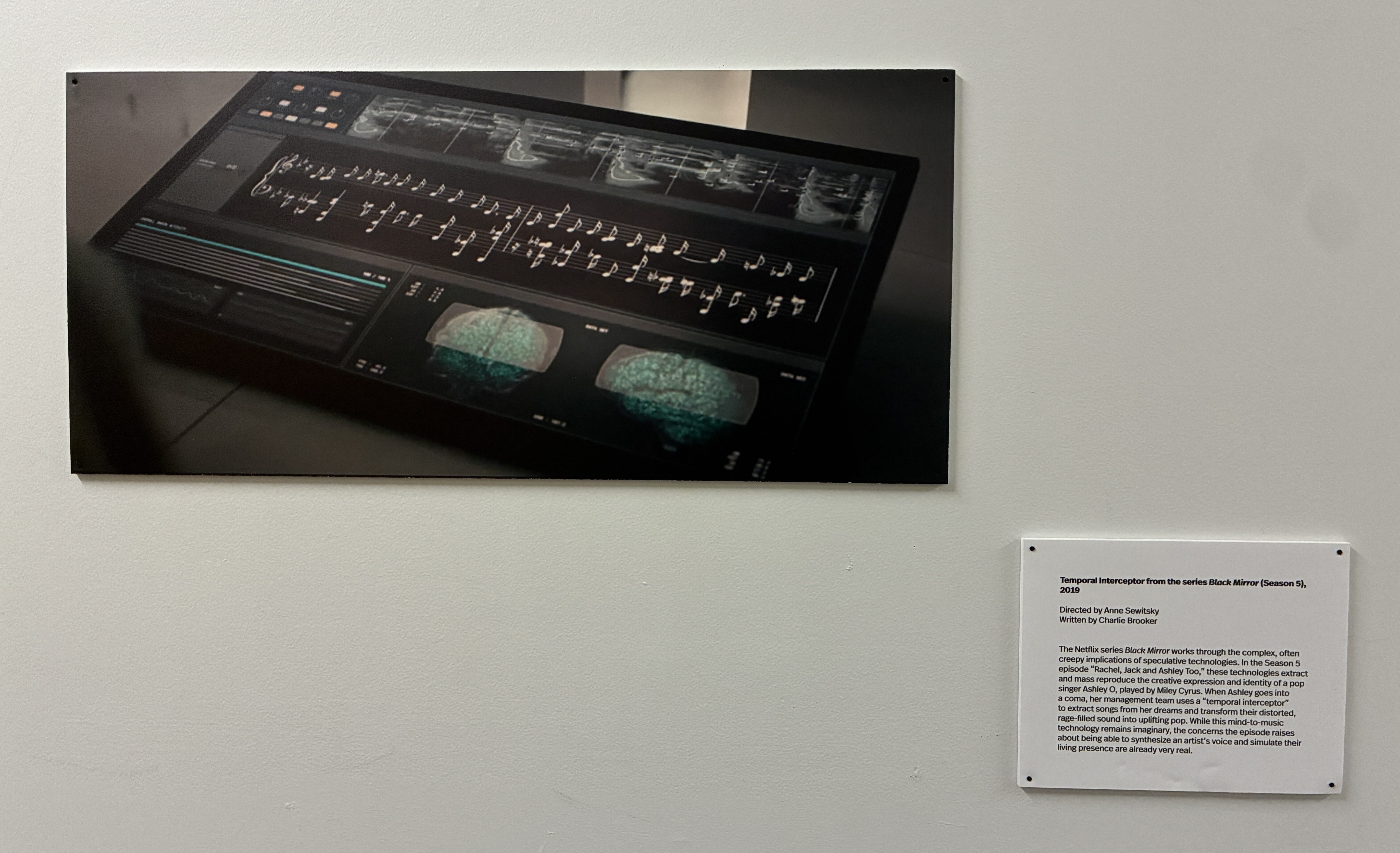
A darker relative is the “temporal interceptor” from Black Mirror‘s “Rachel, Jack and Ashley Too” (2019). It extracts songs from a comatose pop star’s dreams and transforms her distorted rage into uplifting pop. The machine is imaginary, but the questions it raises about synthesizing an artist’s voice are not. The song siphon and the interceptor belong to a whole family of mind instruments in the book, which stretches from medieval automata to Alice Coltrane’s celestial psaltery.
At the edge of the possible
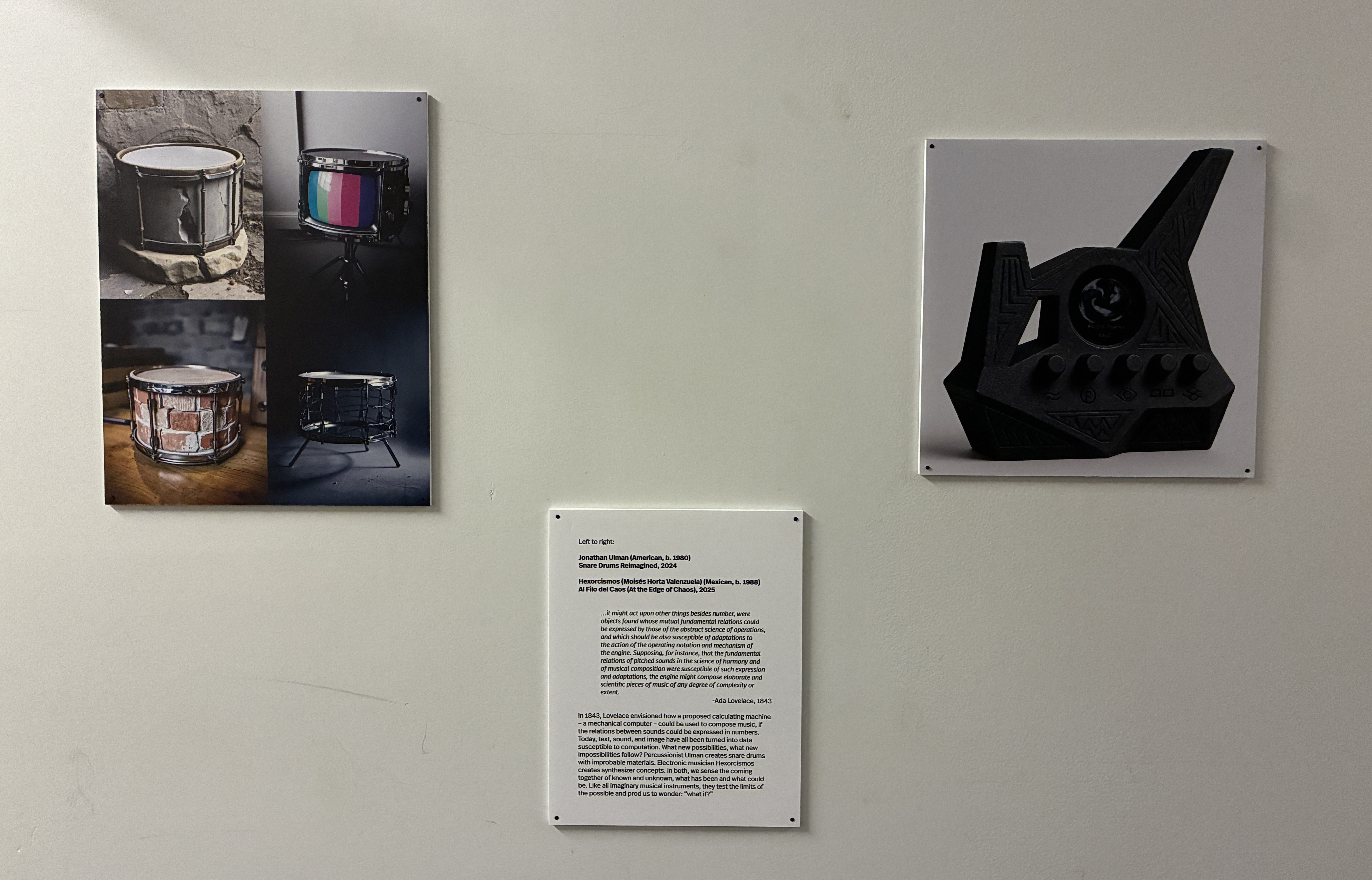
The last wall stands outside the Music Rehearsal Room. In 1843, Ada Lovelace imagined that Babbage’s engine might compose music, if the relations between sounds could be expressed in numbers. Today text, sound, and image have all become data. Two contemporary works respond to that condition: Jonathan Ulman’s Snare Drums Reimagined (2024) and Hexorcismos’s synthesizer concept Al Filo del Caos (At the Edge of Chaos) (2025). Both test the limits of the possible and ask, what if? The book’s chapter on computational instruments follows that question from combinatorics to the present.
Behind the scenes
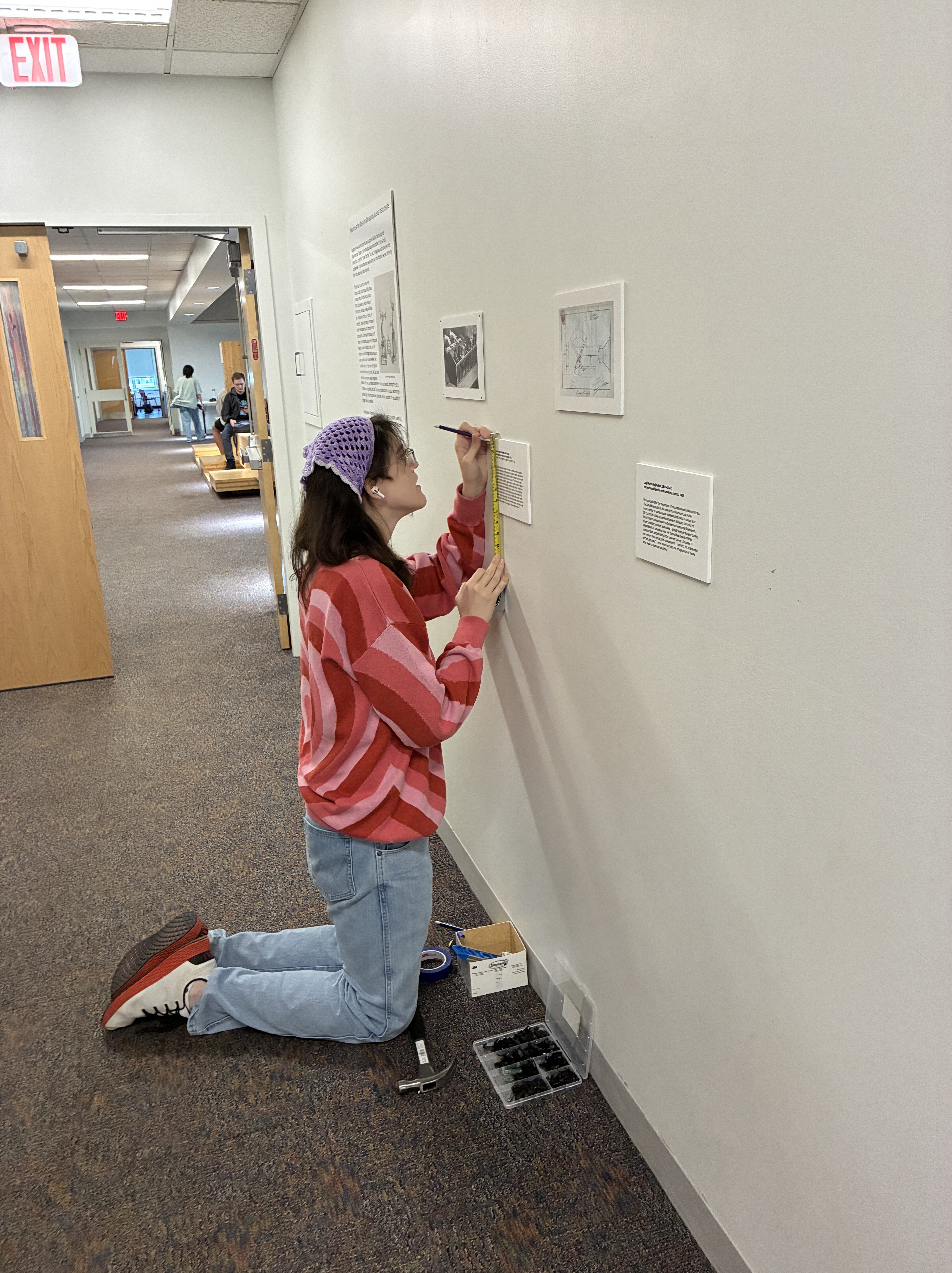
A museum of imaginary instruments still needs a tape measure, a pencil, and a hammer. Many thanks to Evelyn O’Donoghue of the Center for the Arts for her careful work getting everything printed, level and in place.
Things being otherwise
Imaginary instruments can look like pure whimsy. But they are also serious: to conceive of a technology that doesn’t exist is to shed light on the ones that do, and to insist that things could be otherwise.
If this hallway sparked your curiosity, there’s more to explore in The Museum of Imaginary Musical Instruments, available to order wherever books are sold, and at our upcoming events in New York City (October 14), Chicago (November 13) and beyond (see our website for the full schedule).
The showcase is on view on the third floor of Ryder Hall, Northeastern University in Boston, through December.