This blog (formerly Spooky & the Metronome) examines music technology across centuries. I post occasionally when a resonance between past and present feels especially worth exploring, or when there’s news to share about books and projects.
The Museum of Imaginary Musical Instruments Gets a Hallway
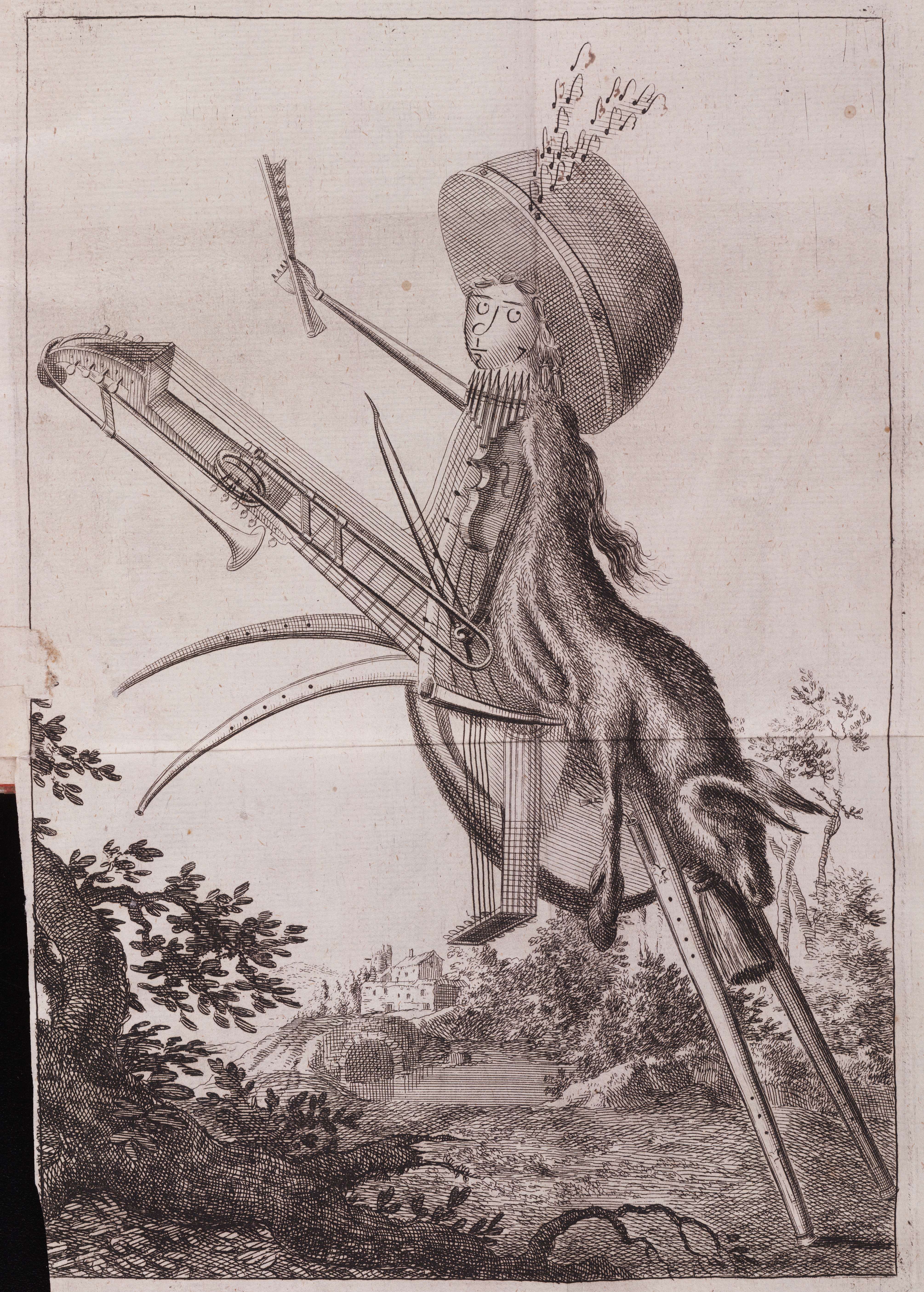
Since 2013, Thomas Patteson and I have curated the Museum of Imaginary Musical Instruments online. This year it became a book, published by Reaktion. And now, thanks to the Center for the Arts at Northeastern University, it exists through December as something you can walk through: a showcase on the third floor of Ryder Hall in Boston, home to the Department of Music.
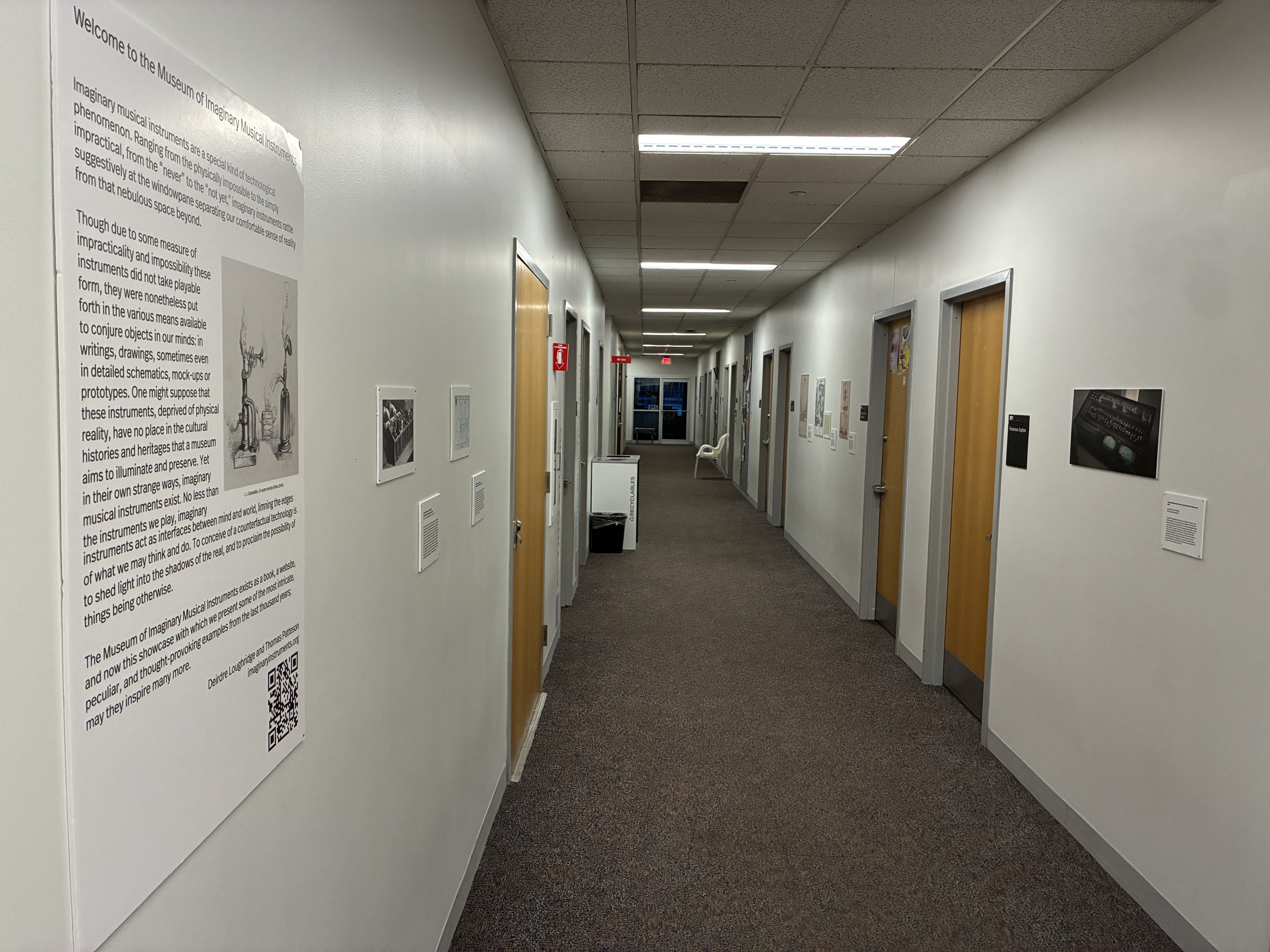
Instruments that don’t exist hang in a hallway lined with practice rooms and faculty offices. During the installation, the sound of people rehearsing drifted through the doors, real instruments being played a few feet from imaginary ones.
I love how this juxtaposition resonates with the spirit of the project. As we say on the welcome panel: imaginary instruments are, no less than the ones we play, interfaces between mind and world; they limn the edges of what we can think and do.
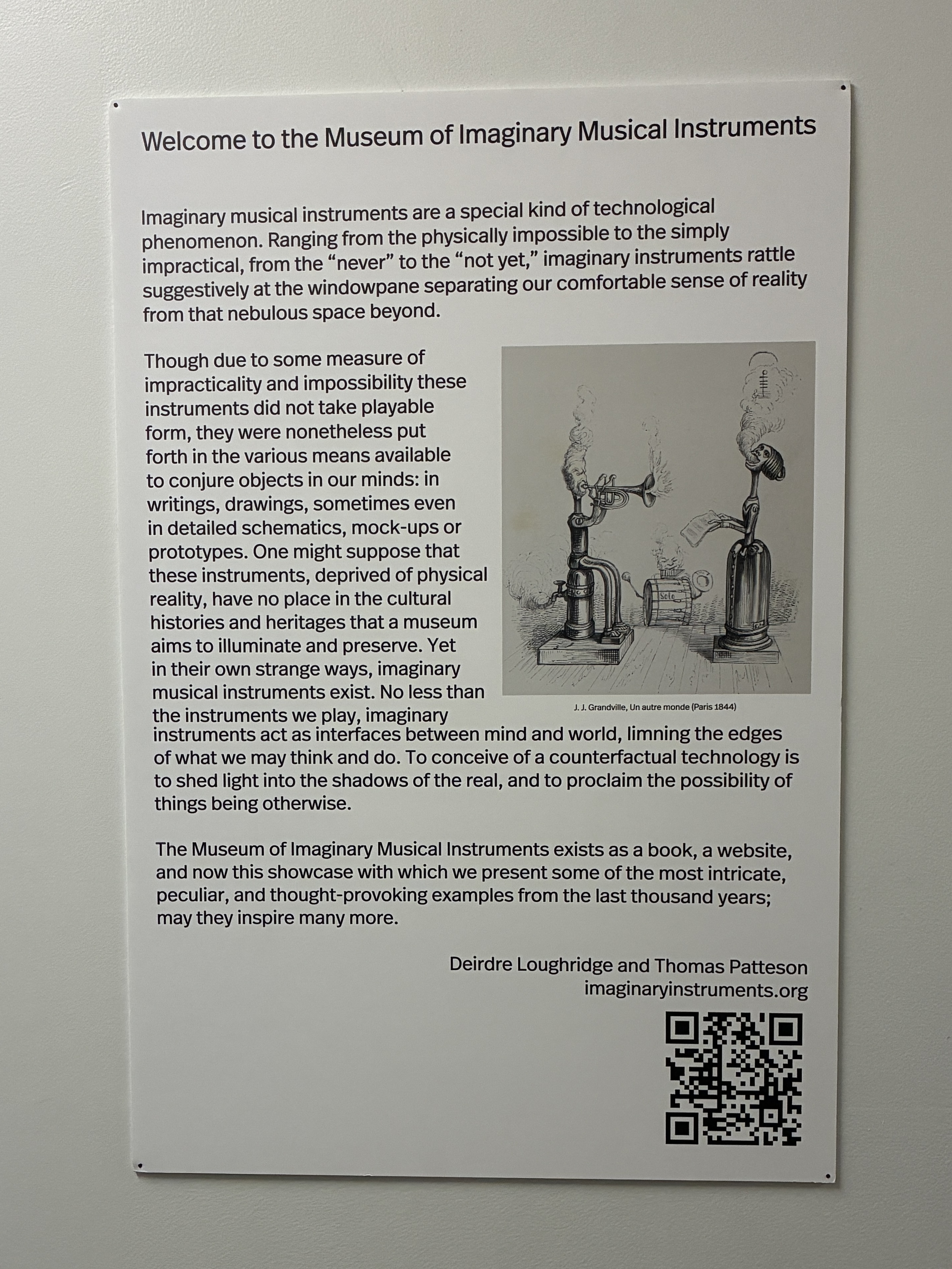
The book gathers far more instruments than any hallway could display (well, at least any practical one). The showcase offers a small sample of how imagination works with the stuff of sound and technology. Here’s a tour through it.
What may have been
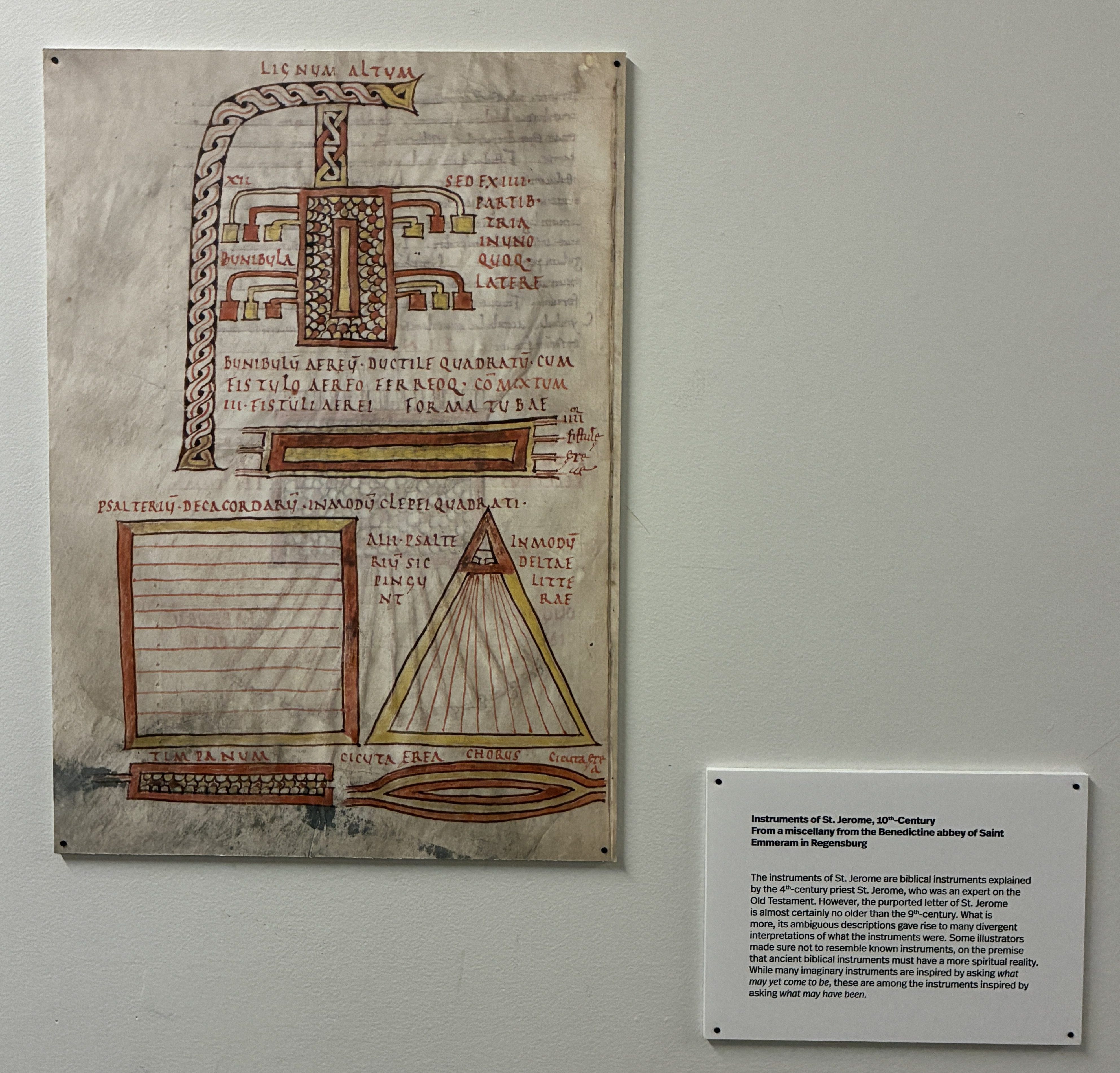
Many imaginary instruments come from asking what may yet come to be. The oldest object in the showcase comes from the opposite question. A tenth-century manuscript from the abbey of Saint Emmeram in Regensburg illustrates the “instruments of St. Jerome,” biblical instruments described in a letter attributed to Jerome but almost certainly written centuries later. Its vague descriptions invited wildly divergent drawings. Some illustrators deliberately avoided any resemblance to known instruments, on the theory that sacred ancient instruments must have had a more spiritual reality.
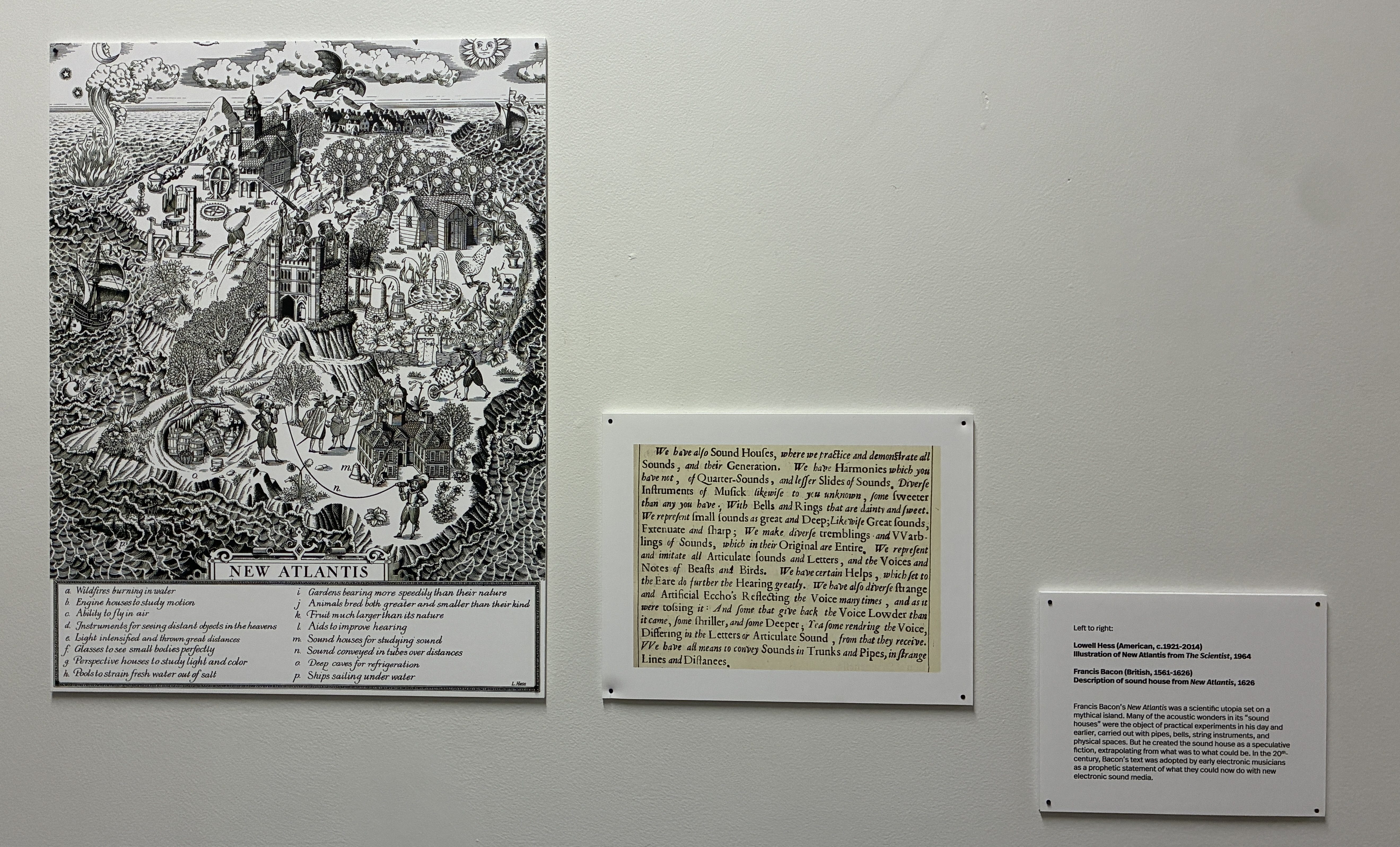
Nearby is the “sound houses” passage from Francis Bacon’s New Atlantis (1626), which describes places for producing and studying every kind of sound, alongside Lowell Hess’s 1964 illustration of Bacon’s utopian island. Three centuries after Bacon, electronic musicians adopted his text as prophecy. Daphne Oram, co-founder of the BBC Radiophonic Workshop, posted it on the studio door and then rewrote it for her own vision. Her story, including an instrument design of her own, is one of my favorites in the book.
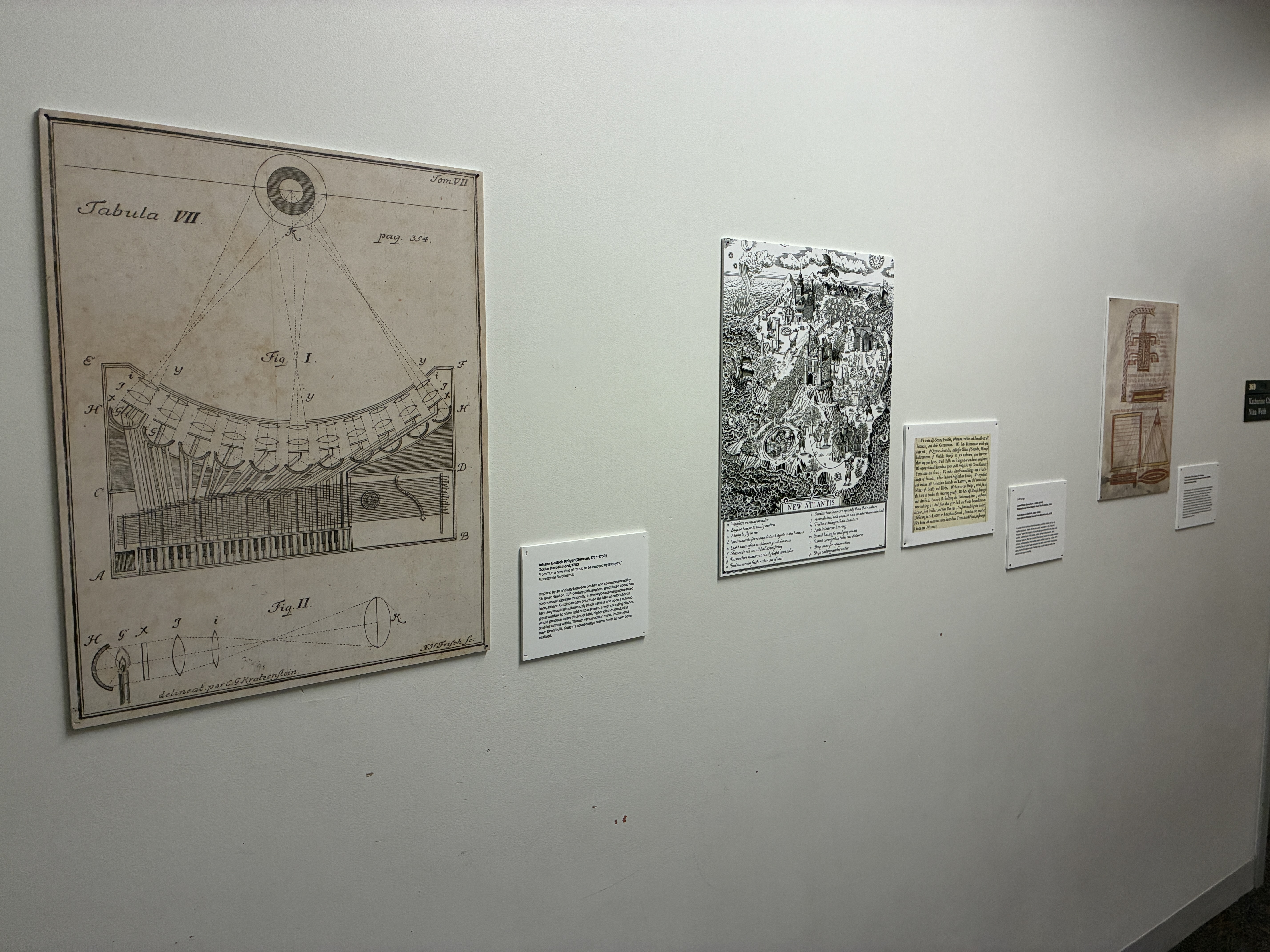
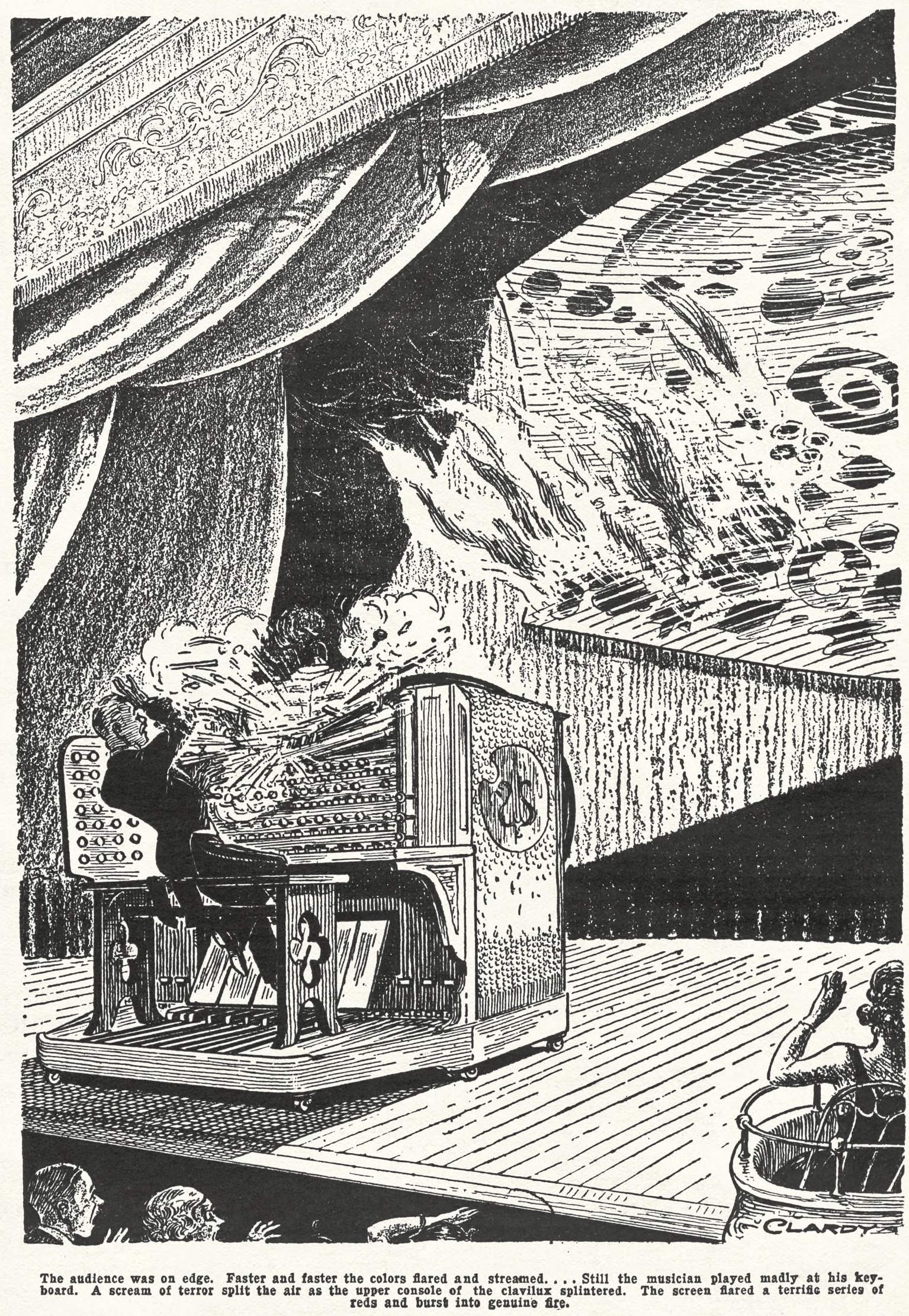
Johann Gottlob Krüger’s ocular harpsichord (1743) would have played chords of light. Each key plucked a string and opened a colored-glass window, following Newton’s analogy between pitches and colors. Other color instruments were built, but as far as we know, this one never was.
Necessary monsters
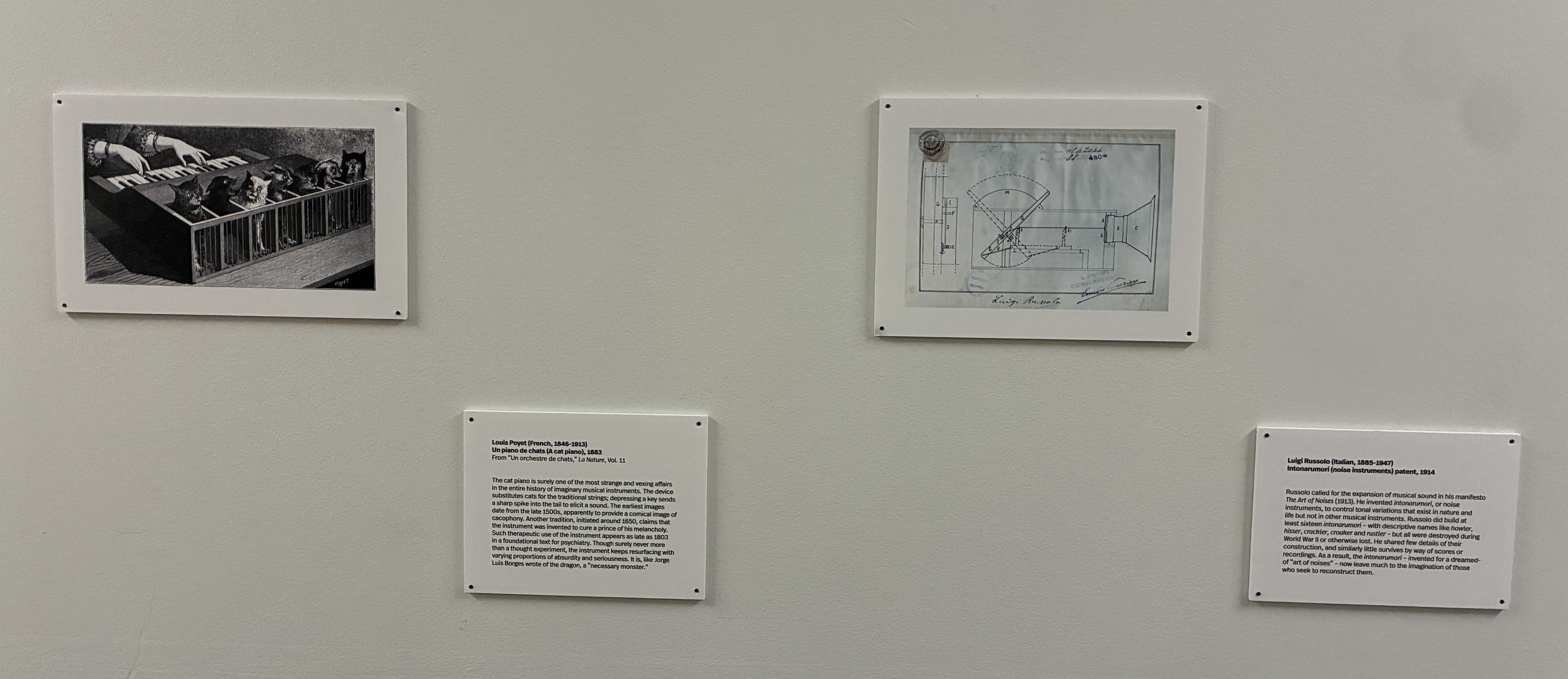
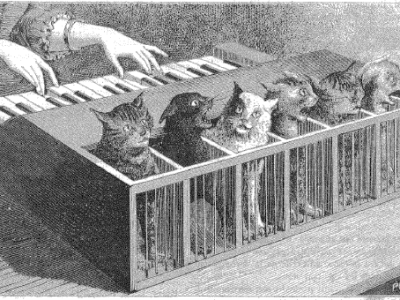
No imaginary instrument is more vexing than the cat piano, shown here in Louis Poyet’s 1883 engraving. It turns up again and again from the late 1500s onward, sometimes as a joke about cacophony and sometimes, disturbingly, as a cure for melancholy. Borges’s phrase for the dragon fits it: a “necessary monster.” Why it keeps coming back is one of the questions the book explores.
Luigi Russolo’s intonarumori went the other way. He actually built at least sixteen noise instruments, with names like the howler, the hisser, and the crackler, but all were lost, along with most of the details of how they worked. An instrument that once existed has become imaginary again, known more as an idea than an object.
Science fictions, comic and earnest
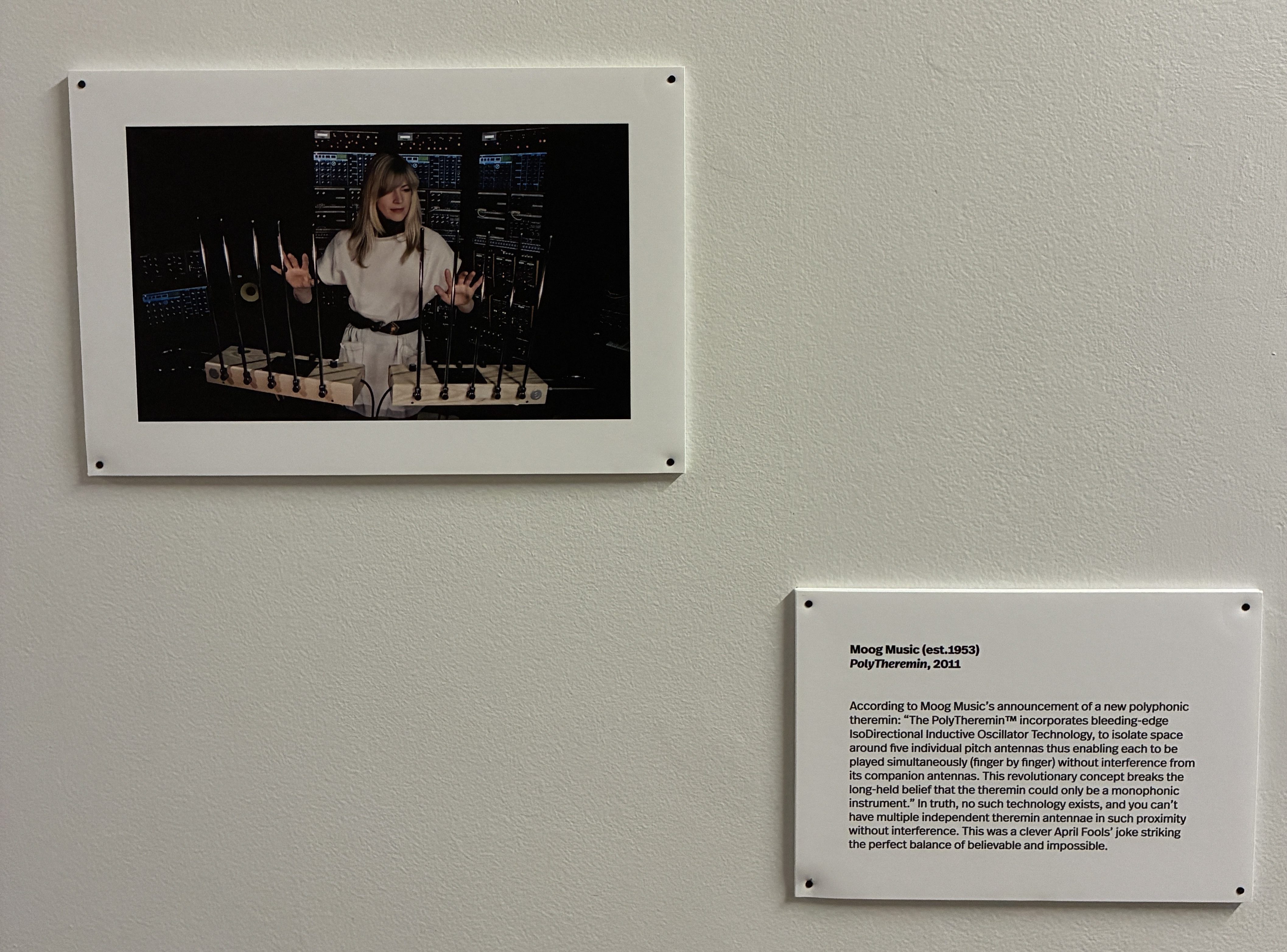
In 2011, Moog Music announced the PolyTheremin, with five antennas played finger by finger. It was an April Fools’ joke, believable and impossible in exactly the right proportions, and demonstrated by the very real thereminist Dorit Chrysler.
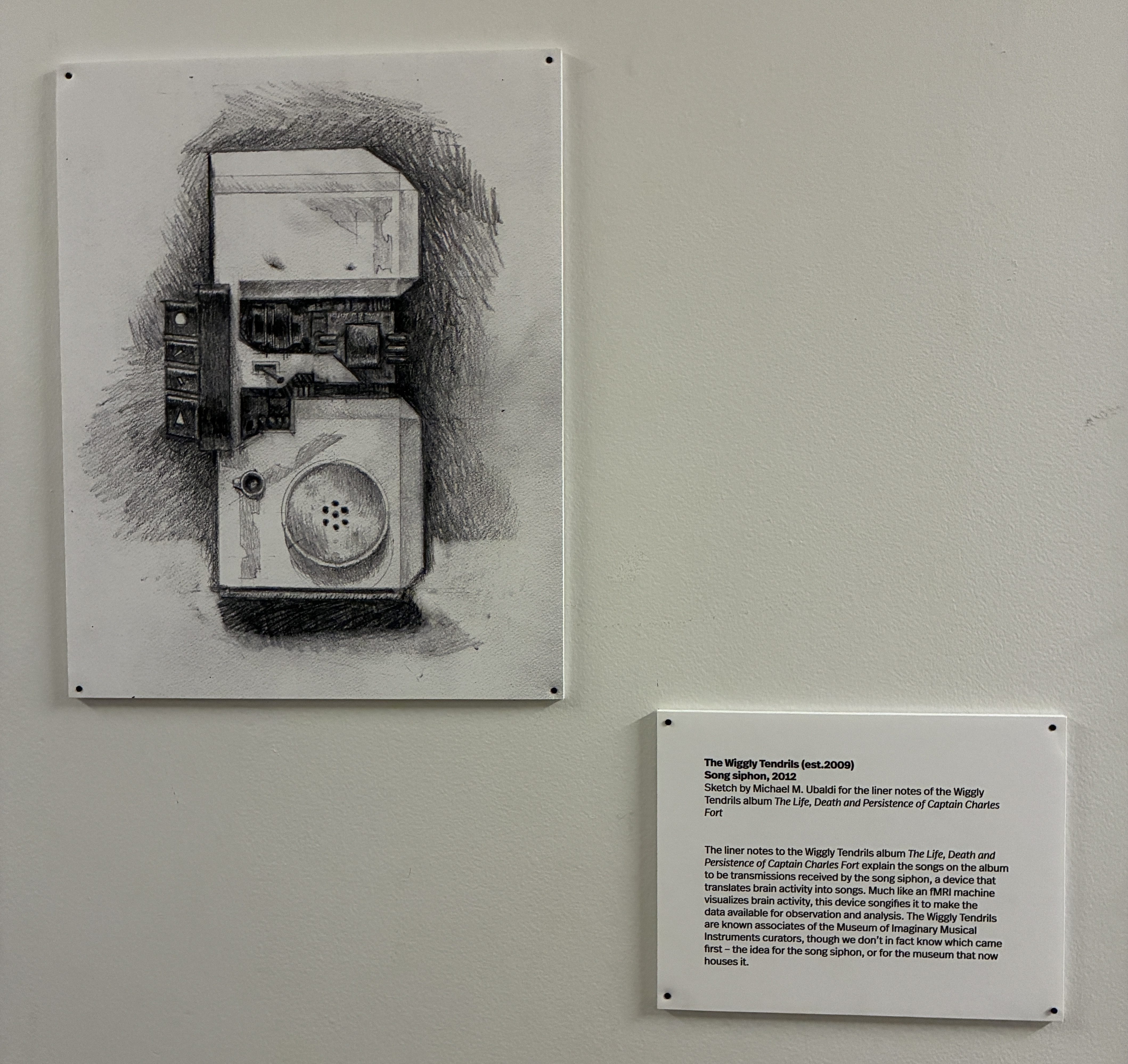
The Wiggly Tendrils’ song siphon translates brain activity into songs. It comes from the liner notes of their album The Life, Death and Persistence of Captain Charles Fort. The band are known associates of the museum’s curators, and which came first, the siphon or the museum, remains unclear. (The Wiggly Tendrils played songs from the album at our Rozzie Bound Books event in September.)
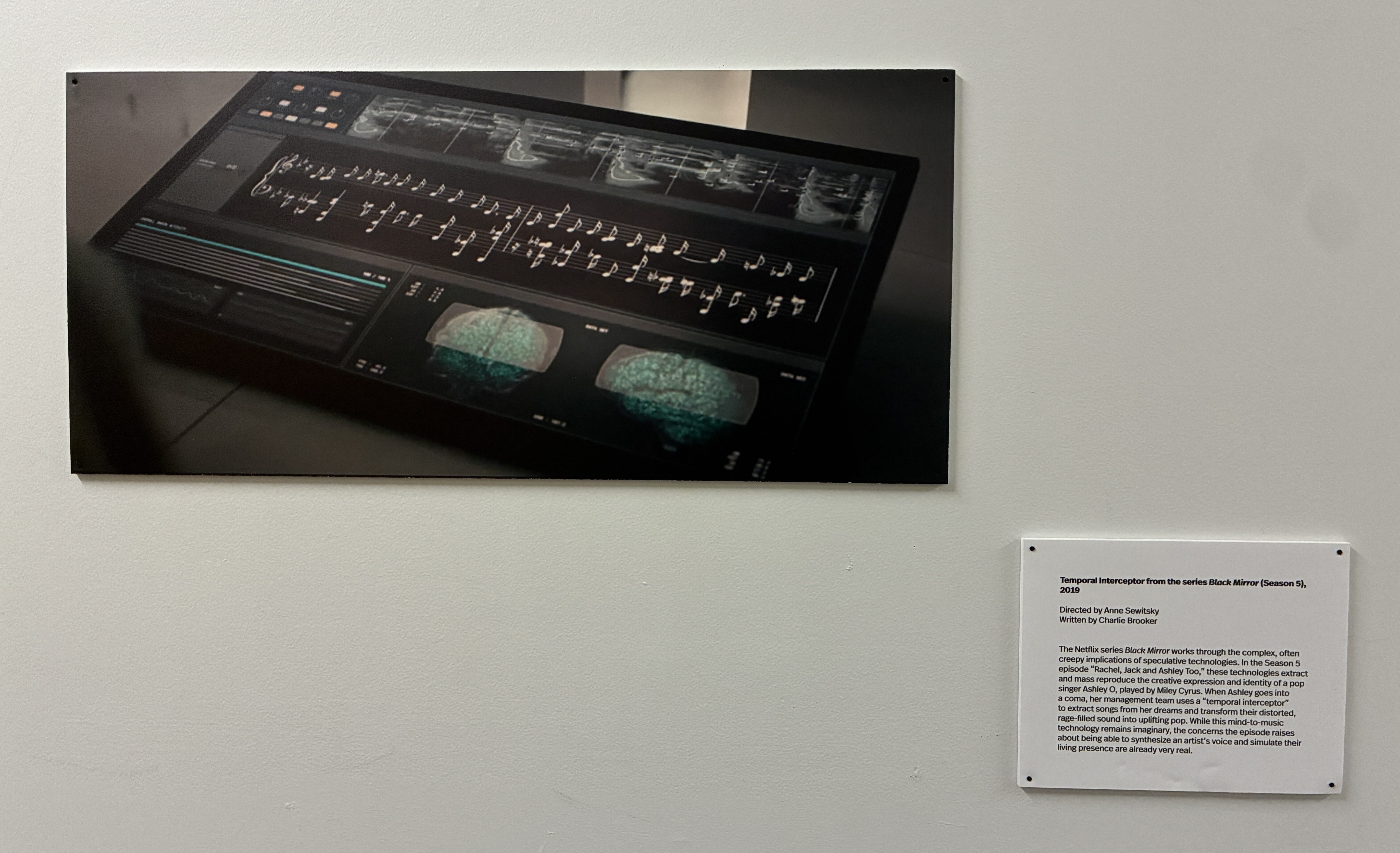
A darker relative is the “temporal interceptor” from Black Mirror‘s “Rachel, Jack and Ashley Too” (2019). It extracts songs from a comatose pop star’s dreams and transforms her distorted rage into uplifting pop. The machine is imaginary, but the questions it raises about synthesizing an artist’s voice are not. The song siphon and the interceptor belong to a whole family of mind instruments in the book, which stretches from medieval automata to Alice Coltrane’s celestial psaltery.
At the edge of the possible
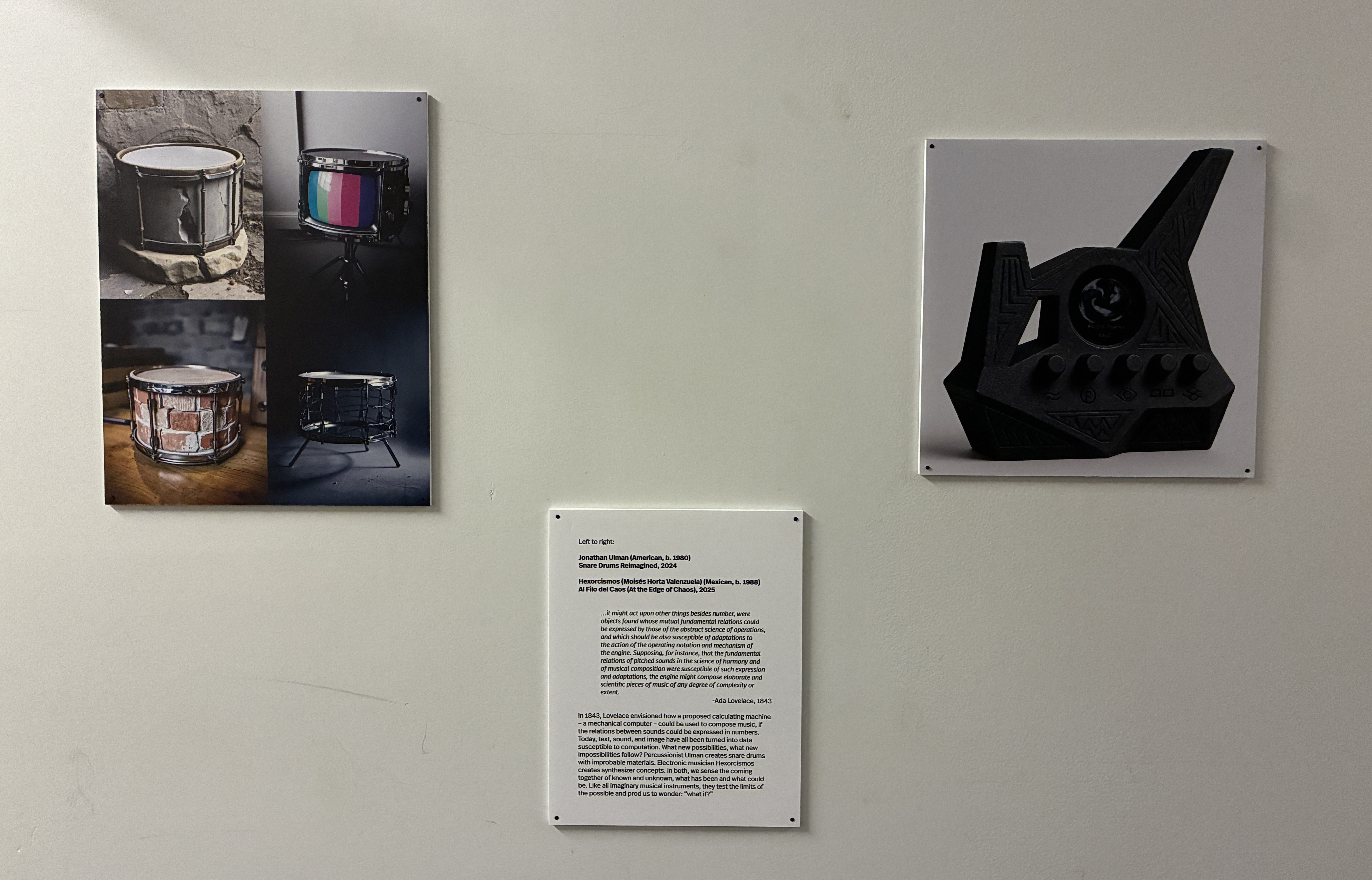
The last wall stands outside the Music Rehearsal Room. In 1843, Ada Lovelace imagined that Babbage’s engine might compose music, if the relations between sounds could be expressed in numbers. Today text, sound, and image have all become data. Two contemporary works respond to that condition: Jonathan Ulman’s Snare Drums Reimagined (2024) and Hexorcismos’s synthesizer concept Al Filo del Caos (At the Edge of Chaos) (2025). Both test the limits of the possible and ask, what if? The book’s chapter on computational instruments follows that question from combinatorics to the present.
Behind the scenes
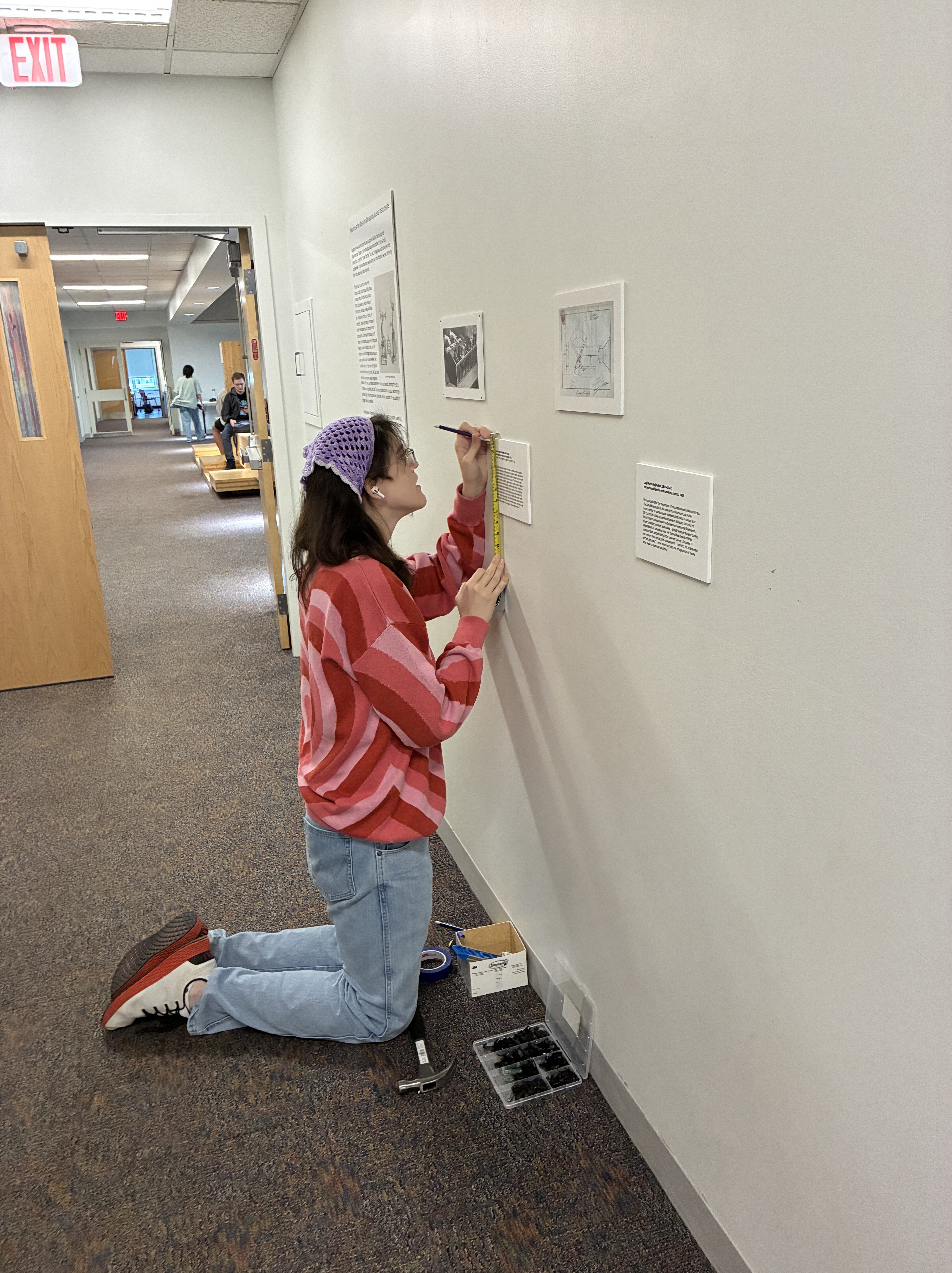
A museum of imaginary instruments still needs a tape measure, a pencil, and a hammer. Many thanks to Evelyn O’Donoghue of the Center for the Arts for her careful work getting everything printed, level and in place.
Things being otherwise
Imaginary instruments can look like pure whimsy. But they are also serious: to conceive of a technology that doesn’t exist is to shed light on the ones that do, and to insist that things could be otherwise.
If this hallway sparked your curiosity, there’s more to explore in The Museum of Imaginary Musical Instruments, available to order wherever books are sold, and at our upcoming events in New York City (October 14), Chicago (November 13) and beyond (see our website for the full schedule).
The showcase is on view on the third floor of Ryder Hall, Northeastern University in Boston, through December.
Upcoming book: The Museum of Imaginary Musical Instruments
As a reader of this blog, you may be familiar with the online Museum of Imaginary Musical Instruments – a site Thomas Patteson and I launched in 2013 to showcase imaginary musical instruments we came across in our research.
Now, it’s becoming a book! And it turns out the world of imaginary musical instruments is even bigger, weirder and more wonderful than we knew. With over 80 images, the book includes some classics from the online museum (like the cat piano and steam concert) and many new gems. We organized these into a guided tour that offers both a cultural history and a study of creative thought, and reveals changing ideas about sound, invention, and the limits of the possible.
The Museum of Imaginary Musical Instruments will be published by Reaktion in 2026, available in April in the UK and July in the US. We hope it sparks something of the joy and wonder we experienced in gathering these remarkable artifacts.
New Book: Sounding Human
My new book, Sounding Human: Music and Machines, 1740/2020, is out now from University of Chicago Press. Much of the music discussed in the book is available on the accompanying Spotify playlist. Read on for a (tweet-per-track) tour through the playlist and some audio/video examples not available on Spotify!
Introduction
Track 1 Mozart, Fantasie in F Minor K. 608 (1791) illustrates a contrast between modern and 18th-century intuitions about music & machines. It was composed for a mechanical organ clock, and as musicologist Annette Richards pointed out, 20th-century critics dismissed the machine as cheapening of Mozart’s music. In its initial reception, the music & its automated performance went together for a heightened awe-inspiring display (one witness described “a thousand varying emotions”). Listen from 8:05 for the increasingly dense and dramatic fugue
Track 2 Kraftwerk, “The Robots” (1978) features the use of a vocoder to turn the voice – and human speaker – robotic. Florian Schneider described their music “expos[ing] the mechanical and robotic attitude of our civilization”
Track 3 Afrika Bambaataa & The Soulsonic Force, “Looking for the Perfect Beat” (1983) illustrates, in words of Tricia Rose, an “already having been robots” for Black people under slavery/capitalism and resistive taking control of the robot guise. Listen at 5:50 “we are the future, you are the past”
Wendy Carlos, synthesized finale from Beethoven’s Ninth Symphony (1971). The vocoded “Ode to Joy” is commonly heard as voices drained of humanity, but for Carlos and collaborator Rachel Elkind it was the sound of synthesizer gaining it by singing. Listen, for example, at 5:55
Track 4 Nona Hendryx, “Transformation” (1983) another alternative to vocoder = robot, Hendryx’s use can be heard to sound the voice of mother nature, dissolving natural versus tech/artificial. Listen ex. at 1:58 in the context of the song
Track 5 From Giovanni Battista Pergolesi, La serva padrona (1730s), the main characters mimic a clock bell and bass drum as the sounds of their hearts/love, to which they direct each other to listen, ex. at :51-1:10
Tracks 6 & 7 Queen of the Night aria from Mozart, Magic Flute (1791) & android Olympia’s aria from Offenbach, Tales of Hoffmann (1881) illustrate leaping vocal virtuosity that became sounding inhuman/like a machine. Listen @ :45 on Track 6 & 1:25 on Track 7
Trk 8 From Mozart’s Magic Flute (1791) at :38 – in contrast to the clockbell of a loving heart in La Serva Padrona (trk 5), bells here make slaves dance automatically, conflating the mechanical and Blackness in a “racist technopoetics” (Chude Sokei’s term)
Chapter 1 Becoming Android: Reinterpreting the Automaton Flute Player
Track 9 From opera Pirame & Thisbé (1726), the melody at :43-1:40 was sung in the play L’Oracle (1740) by a character pretending to be an automaton that can only “parrot…at random,” raising questions about being moved by a machine & being human through its singing
Chapter 2 Hybrids: Voice & Resonance
Tracks 10 & 11 Last Magic Flute example: classic interpretations of these tracks illustrate modern hearing of human versus mechanical sound in voice versus bells
Track 12 Alessandro Striggio “Chi fara fede al Cielo,” appears as hydraulic organ music in a 1615 treatise on machines by Salomon de Caus, and exemplifies what might have sounded as Orpheus’s mythic music in the mechanical grotto featuring Orpheus playing a viola da gamba
Track 13 This Prelude for viola da gamba by Marin Marais features letting strings ring, a technique criticized for “stand[ing] in the way” of melody. Compare beginning (continuous melody) to ~1:35-2:00 (technique used to let notes ring while playing others)
Track 14 This viola da gamba piece by Marin Marais imitates the style of a plucked lute, and captures a perception of lute sound quickly decaying – “tic tac” – rather than ringing out
Track 15 In contrast to the lute-imitative piece, this viola da gamba piece by Marin Marais imitates bells, makes extreme use of letting strings ring (ex. :40), and suggests what a defender of the viol against the violin’s rising popularity meant by its ability to reconcile voice & resonance
Track 16 From a violin sonata by Michele Mascitti (1706), illustrates continuous “voice” sound of violin but played on viola da gamba would illustrate a “sparkling sound” combining melodic voice w/ harmony of resonance (according to a viol defender in 1740)
Track 17 This François Couperin piece for harpsichord features a technique of delaying a melody note to create the effect of a crescendo (an illusion of starting on time and growing louder). This was a means to “give soul to the instrument” and makes the harpsichord exemplary not of lifeless mechanism but of music entangling matter and mind. Effect occurs at :56, 1:02 and most notably 1:17.
Chapter 3 Analogies: Diderot’s Harpsichord & Oram’s Machine
Trk 18 “Four Aspects” by Daphne Oram (1960). Oram used to illustrate crescendo requiring more than just increased volume: “To get a real feeling of crescendo one has got to…put more & more high frequencies into the tone color as well.” Listen 2:16-3:37
Trk 19 “Contrasts Essconic” by Daphne Oram, performed @ First London Concert of Electronic Music by British Composers (1968). Its contrasts were in mood & sound sources, which included piano, tone generators, musique concrète & the debut of “Oramics” the “graphic sound” system Oram invented for hand-drawn control of electronic sound. Oramics most likely heard at 3:56-4:50 and 5:40-6:43.
The 1968 concert also featured Peter Zinovieff’s “Partita for Unattended Computer,” which got media attention as the “first concert performance ever by a computer.” Featured in this Tomorrow’s World episode – what became sound of “computer thinking” @ 3:40 https://www.bbc.co.uk/archive/peter-zinovieff–early-electronic-music/zmyf7nb
Excerpt from BBC radio program World at One (1972) in which Daphne Oram demonstrates her “method of translating visual wave patterns into musical sound, in a way that retains the human element” https://research.gold.ac.uk/id/eprint/26356/27/011_Oram_1972_Interview_Excerpt.mp3
Chapter 4 Personifications: Piano Death & Life
New York Times 2012 coverage of pianos going to the dump & responses to it start Chapter 4’s inquiry into personifying pianos:
Annea Lockwood, Piano Burning (1968) https://www.utne.com/arts/bonfire-of-the-ivories-visualize-your-piano-burning/
Chapter 5 Genres of Being Posthuman: Chopped & Pitched
Track 20 Calvin Harris and Rihanna, “This is What You Came For” (2016). The “yooo ooo ooo”s were the 2016 sound of “people don’t want to sound like people anymore” (according to one music critic)
Track 21 Kiiara, “Gold” (2016). Producer Felix Snow described “manipulating vocals to sound like a computer and vice versa” as “the first tiny step toward the computer doing all of the singing”; Kiiara observed, “it’s a sample. That’s all it is.”
Track 22 Zara Larsson and MNEK, “Never Forget You” (2016). In contrast to pitched and chopped lead vocals, processed vocals in instrumental textures ex. 1:07-1:33
Track 23 T-Pain featuring Ludacris, “Chopped N Skrewed” (2008). This 2001: A Space Odyssey parody really sums up autotune anxieties ca. 2008
Track 24 Cher, “Believe” (1998), the breakthrough hit for the sound of autotuned vocals frequently characterized as “robotic”
Track 25 Flume featuring kai, “Never Be Like You” (2016) exemplifies ca. 2016 EDM-pop’s taste for “feathery” female vocals, ex. :19 and 3:30
Track 26 MNEK, “At Night (I Think About You)” (2016), in which producer-singer MNEK manipulates his own voice with and without the computer, as he discusses in this interview esp. at 3:05 https://www.bbc.com/news/entertainment-arts-36744245
Coda: Learning Machines
Track 27 David Cope, “From Darkness, Light” (2010) illustrates one pole of AI in the socio-musical imaginary, with anthropomorphic name Emily Howell emphasizing humanlikeness and implying its generalization to autonomy, etc.
George Lewis and Vijay Iyer in Concert (2012) with Voyager, which they discuss @ 36:30, foregrounding both its need for help to function and capacity for disobedience (a sociomusical imaginary for AI between the extremes of autonomous or “just a tool”)
Track 28 Laetitia Sonami, “Breathing in Birds and Others” (2017) stands in for this artist by Sonami in 2013, where she demonstrated her bird with magnetic coils (47:40); this talk was my introduction to neural nets https://archive.org/details/sonami
Trks 29-30 are from Dadabots, Can’t Play Instruments, Vol 1 (2021), an album of neural network-generated hardcore punk that continued the duo’s front of humanless musical creation (while elsewhere databots discuss “using the neural nets as an instrument”)
Track 31 Holly Herndon, Jlin, Spawn, “Godmother,” PROTO (2019) lent itself to idea of AI acquiring sentience
Tracks 32-33 Jlin’s “Expand” (2015) & “Embryo” (2021). Listening to these tracks clarifies “Godfmother” as the sound of a model trained on Holly Herndon’s voice & style transfer to Jlin’s music
Jennifer Walshe and Memo Akten, Ultrachunk (2018). Walshe describes performing the neural network trained on her voice as working with an “alien intelligence”
Hexorcismos, Transfiguración (2020). Another example of alternative to likening/comparing AI to human, Hexorcismos describes “approaching the Neural Network as an alchemical technology,” which aptly characterizes the process of style transfer
Tracks 34-37 Arca, “Riquiquí” (2020) & from Riquiquí; Bronze-Instances(1-100) (2020), the album of its 100 remixes via AI – or in her term that steps outside the usual frame of human comparison to contemplate machine capabilities, “intelligent sentience”
Something went wrong. Please refresh the page and/or try again.

