Tag: Haydn

  • The Auto-tune Debate Before Auto-tune

    Auto-tune: it’s the ubiquitous digital effect that gives pop singers’ voices that robotic quality, that you may know from the Youtube phenom auto-tune the news, and that recently prompted Alex Pappademas to start a three-part New York Times blog series with the question: “really now, what’s so bad about auto-tune pop?”

    Pappademas speaks to the many who find auto-tune repugnant, and especially to those who justify their (dis)taste for the effect as a matter of standards.  As he observes in installment #3:

    the biggest criticism Auto-Tune’s critics level against it is that it’s the sonic equivalent of plastic surgery or ‘roids, a digital fix that lets lousy singers skip over that whole learning-to-carry-a-tune thing (boring!) and cut straight to pop stardom’s V.I.P. room.

    Auto-tune, in short, is a musical cheat, to which Pappademas replies:

    The truth is that artists and producers have been using technology (reverb, overdubbing, electronic harmonizers) to change the sound of their voices for decades. The link between “organic” live performance and recorded music was broken in the late ‘40s when Les Paul popularized multitrack recording.

    Indeed. But the arguments surrounding auto-tune aren’t unique to vocal effects, and they long predate recorded music. In fact, the same arguments have perennially attended tone-modifying devices of all sorts: many technologies for altering the sound of an instrument were once regarded as crutches but went on to gain acceptance as expressive resources, ultimately becoming part of what it means to know how to play or compose for a given instrument. This is the story of two tone-modifying devices whose detractors have fallen silent: the violin mute, and the sustaining pedal.

    The Violin Mute

    The violin mute was invented in the seventeenth century, and is a device applied to the bridge of the violin to dampen its sound.  The French composer Lully was one of the first to call for muted violins in a written score, pairing them with recorders in a depiction of enchanting, soporific murmurings in the opera Armida (1686):

    By the middle of the eighteenth century, however, French critics regarded the mute as a crutch for violinists incapable of playing softly.  As one writer remarked in an article on performance in the Encyclopédie:

    It is well known that in Lully’s lifetime the violinists needed to resort to mutes in order to play softly enough in certain passages.

    If this view of the mute as a substitute for skill had persisted, the mute no doubt would have become obsolete.  Elsewhere in Europe, however, composers and listeners perceived the mute as giving the violin a special tonal quality that violinists without mutes could not match.  And so composers continued to call for violin mutes for that special tonal quality, often combining it with slow, flowing music to produce the peaceful or dreamy atmosphere pioneered by Lully.  Today, critics reserve their venom for violinists who fail to use mutes when they should.  Speaking of the violin mutes in Haydn’s Il mondo della luna (1777), period performance specialist Nikolaus Harnoncourt recently remarked:

    Players are lazy and think it’s enough just to play very softly. But when composers write ‘con sordino’ — ‘with mute’ — they want a very particular, different sound…The idea was just to hear quivering air.

    Nikolaus Harnoncourt conducts “Vado, vado” from Il mondo della luna – with mutes

    The Sustaining Pedal

    The piano was one of the major technological breakthroughs of the eighteenth century, trumping the harpsichord with its touch-sensitivity and the clavichord with its greater volume.  Early on, piano manufacturers experimented with ways of modifying the piano’s tone, eventually arriving at pedals as a hands-free way to apply tone-modifying devices. Many players, however, considered piano technique a matter of fingers only, and pianists who used pedals were commonly charged with charlatanism – with resorting to technological trickery to mask a lack of keyboard skill. Such was the case with the sustaining (or damper) pedal, which when depressed allowed the strings of the piano to resonate even after the finger had been lifted from the key.  The sustaining pedal was criticized as a cheat for finger legato, and also for producing a muddled blur of sound. As late as 1828, the pianist-composer Hummel maintained:

    a truly great artist has no occasion for the pedals…Neither Mozart, nor Clementi, required these helps to obtain the highly deserved reputation of the greatest, and most expressive performers of their day.

    By this time, however, the tides were turning.  As Beethoven’s student Carl Czerny observed:

    by means of the pedal, a fullness can be attained which the fingers alone are incapable of producing.

    Initially, composers used the sustaining pedal primarily for special effects, reserving them for unusual passages that stood apart from their surrounding context. One of Beethoven’s comparatively rare indications for sustaining pedal, for example, occurs in the opening of the Tempest Sonata, where it sets off slowly accumulating chords from the hurried Allegro theme.
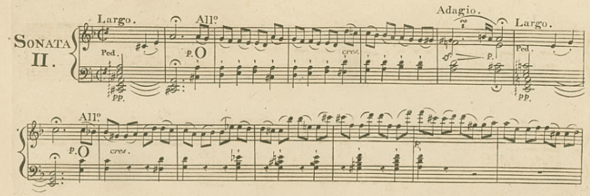
    Beethoven, Piano Sonata Op. 31 No. 2 (Tempest), first movement, first edition (Bonn, 1802)

    The mid-1800s, however, witnessed a period of “pedal mania” during which pedaling became ubiquitous, and composer-pianists developed not only modern pedal technique but also new musical styles premised on use of the sustaining pedal. Chopin and Liszt were two of the chief architects of this development. The nocturne style that became Chopin’s trademark, for example, required the pedal to sustain the down-beat bass notes while the left moved to play mid-register chords, and to continue the cantabile legato across large (highly expressive) leaps in the right hand melody:

    Arthur Rubinstein plays Chopin’s Nocturne Op.9 No.2

    Today, pianists are so used to the sustaining pedal that they often react negatively to the sound of the piano without it – even when playing music composed for finger legato.

    Tone-Modifying Devices & Musical Evolution

    What we’re seeing with Auto-tune, then, isn’t just a discussion of taste masquerading as a discussion of standards. It’s part of the process by which new technologies are incorporated into musical practice, transforming from crutches (which replace something old) into expressive resources that enable new musical styles and require new musical skills.
  • Everything New is Old Again: Minna Choi, Kapellmeister for the 21st Century

    There has of late been much hand-wringing over the future of the orchestra.  And for good reason.  Orchestras are filing for bankruptcy left and right – and not just mid-level orchestras like Syracuse and Honolulu, but top-tier orchestras like Philadelphia.  In recent months, WQXR asked five experts to address the question, “Are American orchestras are an endangered species?”  Joseph Swenson told The New York Times, “huge institutional orchestras are like imperialist armies that have over-extended themselves.” And Norman Lebrecht at the British magazine Standpoint declared a crisis of global proportions: “Realists are demanding to know exactly what a city of six million wrestling with post-industrial decline gains from having a costly and cumbersome musical pantechnicon.  Who needs a symphony orchestra?  That’s what they are asking, the world over.”

    For every doomsayer predicting the extinction of the orchestra in this discussion, there is an optimist declaring the orchestra immortal as the jellyfish.  In the above mentioned WQXR video, Raymond Hair cites data that Americans continue to spend money on the performing arts, and concludes that the survival of the orchestra as we know it simply requires better management.  According to Norman Lebrecht at Standpoint, we need orchestras now more than ever because “the symphony orchestra is our relief from the communicative addiction”:

    the symphony orchestra will always survive — not on the weary old argument that it is somehow “good for you” to listen to “good music”, nor on any cod theories that classical music breeds clever kids and better citizens, but simply because there is a cogent human need for what an orchestra adds to the relief of city life. That need becomes ever clearer as the world speeds up.

    Sounds good.

    Except for the reality that the symphony orchestra as we know it is an institution of the industrial age, and we are living in an information age.  The former prized monumentality at any cost, fidelity to the self-expression of the artistic genius, and the eternal perfection of the work of art; the latter prizes efficiency, sustainability, interactivity and the particularity of now.

    Which is why the future of the orchestra may look something like this:

    The Magik*Magik Orchestra, as their website says, “is a modular orchestra with a focus on collaboration.”  By modular, they mean that they play in any configuration, from a soloist or string quartet up to their full roster of 60+ musicians.  By a focus on collaboration, they mean that they play primarily with (rock) artists seeking instrumentalists for their recording or performance projects.  And by orchestra, they mean what you would expect: an organization of conservatory-trained musicians on classical Western instruments, who play together under the direction of a conductor – in this case Minna Choi, also the orchestra’s founder.

    Here’s a sample of the Magik*Magik Orchestra in action, in concert with the Dodos (please forgive the sound quality):

    Now, before you dismiss Magik*Magik as a back-up pops orchestra, not a real orchestra, consider Minna Choi’s response to an interviewer at The Bay Bridged, who asked “What do you think separates Magik*Magik from other orchestras, musically or culturally, or in terms of the organization’s aesthetic?”  Situating her orchestra in relation to the type of orchestras now declaring bankruptcy, Choi replied:

    Most orchestras today exist as stand-alone entities. They perform season concerts, and sometimes have guest artists come in to play with them, but almost everything they do is just the orchestra. Magik, however, is almost entirely collaborative, so we’re always supporting or playing with a band, we rarely perform just by ourselves. Also, it’s one of our goals to be as accessible to everyone as we can, and I think that people see us that way–a band who has never worked with orchestra players before can come to Magik and get an arrangement written for their song, and an awesome group of players to track the song.

    Magik*Magik is now the “orchestra in residence” at Tiny Telephone, a studio frequented by indie rock artists for whom Choi writes chamber/orchestral arrangements to order, and leads her musicians on demand.  This indeed sounds nothing like the orchestra of the industrial age, with its regular schedules and timeless works.  But it sounds quite a bit like the orchestra of another age – the one we call the Age of Enlightenment.

    In the eighteenth century, composers and musicians were employed by courts or churches to provide music on demand, whether the occasion be a religious service, a political ceremony, or a social entertainment.  The composer who wrote the music for the occasion also directed the performance – he was in charge of the musicians and responsible for satisfying the musical needs of his employers.  Such a director was called a Kapellmeister, and it was as Kapellmeister that Bach composed his Brandenburg Concertos, and Haydn his Farewell Symphony (to give just two examples that, by later standards, transcended their immediate purpose) .

    Minna Choi is the Kapellmeister for the 21st-century.

    In the late eighteenth century, the court orchestra went into decline.  This decline resulted from the same factors that enabled the birth of the orchestra as an independent, public institution (namely, industrialization and the rise of the middle class).  Just as Haydn’s princely employer dismissed the staff of musicians from the court at Esterháza, a musical entrepreneur contracted Haydn to present new symphonies in public concerts in London.  Court patronage and ticket-purchasing public – at the end of the eighteenth century, the latter replaced the former as the economic foundation of the orchestra.  Now the pendulum swings back to patronage, with the difference that indie rock artists, rather than royality, are the patrons.

    By being the Orchestra of the Information Age, Magik*Magik revives a long dormant tradition of orchestral music made to order, on demand, for the moment.  Whether this model will take over from the symphony orchestra as we have known it for the last century, will coexist with that orchestra, or will remain a unique experiment remains to be seen.  But to use Joseph Swenson’s words, the Magik*Magik Orchestra suggests one way that “the new modern symphony orchestra will once again be a living, breathing, flexible and curious organism.”

    The Orchestra of the Future?