Tag: music streaming

  • Music in Times of Pestilence

    When I see things like “your anti-anxiety playlist,” my mind usually reaches for the critique drawer. I think of things like Paul Allen Anderson’s take on “neo-muzak and the business of mood,” with its suspicions of playlists designed for “mood enhancement…like a regular Prozac or other selective serotonin reuptake inhibitor (SSRI) regime, those ubiquitous drugs sold to simultaneously elevate mood (without inducing mania or euphoria) and sedate anxiety (without inducing sleepiness).” For Anderson, the extended pharmacological analogy underscores a critical point: streaming services encourage us to play with moods not in the interests of our well-being but in the interests of capitalism.

    But now that things like “your anti-anxiety playlist” are circulating in direct response to a global pandemic that is rippling through communities, taking lives and livelihoods, separating friends and loved ones, turning things upside down, and throwing the future into extreme uncertainty – the critique drawer isn’t seeming so useful. What can music offer us in this time – a time when risk of contagion challenges music’s usual powers to bring people together? Would it be so bad if music were a bit like medicine?

    And so instead, I’m reaching for other ways to think about the roles of music in this moment – and finding parallels in earlier times of pestilential crisis. In Music and Plague in the Renaissance (2017), Remi Chiu examines “music’s place in the pestilential pharmacopoeia.” He focuses on a period of recurrent plague outbreaks between 1400 and 1600, which produced a “growing sense of experience and habituation for the professional charged with plague management,” and led to “general routines and patterns of response to plague for this period.” Even though the medical thinking of the period differs in many respects from that of today, many of the management strategies developed – quarantines, embargoes, surveillance, limits on social gatherings – remain standard practice. As Chiu demonstrates, “music and music-making” were also among the period’s “resourceful strategies for surviving plague,” with attention directed to music’s effects on the body, the soul, and the community.

    Mood Management

    Music was regularly discussed in Renaissance treatises on the plague, in the context of how external phenomena impact the state of one’s body and mind. Doctors focused on the power of joyful, happy music to defend against plague, recommending music-making along with activities such as story-telling and games that could be enjoyed in the safety of intimate, domestic settings. An anonymous author wrote in one of the first plague treatises (1405) that music, along with “good hope and imagination” is “often more useful than a doctor and his instruments.” The German Johannes Salius (1510)  recommended, “play the harp, lute, flutes and other instruments. Let songs be sung , fables be recited, joyful stories be read, and the songs of the lighthearted muse be played.” According to Nicolas Houël (1573), “keeping to yourself and being solitary is not good, but neither is being in a large crowd; find happy people and honest recreation, occasionally sing, play flutes, viols, and other musical instruments.”

    Religious leaders, on the other hand, were suspicious of sensory pleasures, which might be among the vices that called down divine punishment in the form of plague. Musical joy might be good for the body, but too much was a danger for the spirit. Chiu shows how composers reconciled these conflicting recommendations through music that juxtaposed contemplative, devotional passages with livelier, more dance-like passages. Such a balancing act can be heard in Guillaume Dufay’s “O beate Sebastiane,” a piece composed in the 1430s and addressed to St. Sebastian, the defender against plague. The piece features serene chords on the name of the saint “Sebastiane” (:34-:52 on the track below), followed by more rhythmically active, flowing singing on the words, “great is your faith: intercede for us with the Lord Jesus Christ so that we may be delivered from the epidemic plague and sickness.” The two styles come together on the concluding “amen” as unified chords combine with a hopefully rising melody (2:25-end), sounding a joy that is good for both body and soul.

    Today, the competing health claims of the contemplative and joyful have their counterpart in music recommendations focused on the calming or the energizing. NPR has emphasized music’s calming, anti-anxiety powers, with quiet, introspective, down-tempo songs like Julie Byrne’s “Natural Blue” selected to soothe the nerves and relieve stress. Others have turned to music for uplift, motivation, affirmations that “we got this,” “we can,” or “we will.” Recommending The Pointer Sisters’ “Yes We Can Can,” for instance, Danyel Smith remarks, “I’ve got to have the exuberance right now because I’ll spiral.” She also notes the importance of lyrics, due to the dangerous scope instrumental music provides for her own imagination: “I’ll impose too much of my own thoughts onto an instrumental.” In a rare instance of finding the contemplative and joyful in one and the same place, Felix Contreras recommends the music of Cuban instrumentalist Omar Sosa, writing: “His music has always managed to inspire both joy and reverence…This week, I call upon the reverence, joy and calming nature of Omar Sosa’s music to help us all deal with the uncertainty and — for some of us — fear of an unstable immediate future.”

    Yet others have sought music not to alter their mood so much as to resonate with their emotional state or situation. As New York Times music critic Jon Caramanica remarks, “It’s hard for me to listen to something that’s far away from where I already am internally, so I find myself in moments like this – I’m in the anxious parts of my catalog.” He suggests that through such listening, he “displaces” his feelings onto the music. Similarly, Matthew Ismael Ruiz faces the chaos by listening to the noisier passages of Merchandise’s “Become What You Are”, while Chris Douridas’s “Quarantine Playlist” features songs that take on new meaning in connection with pandemic-mandated isolation or reclusive intimacy, such as Willie Nelson’s “Hello Walls.” “Chris,” radio host Jeremy Hobson remarked after several such recontextualized songs about staying home, “you’re making me feel a little bit better about this whole quarantine situation.”

    Community

    The tools of individualized musical mood management are readily adaptable to quarantine conditions – and if we were to adopt Anderson’s critical mode, we would “depict the self-composing neo-Muzak user” as a kind of butterfly who emerges from their listening cocoon to “flutter among their online friends and followers in a semblance of solidarity.” There would be no reason to envision such users confronting the challenge of how to balance the benefits of communal music-making with those of social distancing – as the citizens of Milan did during the plague outbreak of 1576-1578. There, Cardinal Carlo Borromeo instituted what Chiu describes as an “innovative program of public devotion [that] kept Milanese isolated and safe.” Citizens were instructed to sing from their doors and windows, coordinated in call and response. As one observer reported on this musical adaptation to plague conditions, “when the plague began to grow, this practice [of singing the litanies in public] was interrupted, so as not to allow the congregations to provide it more fuel. The orations did not stop, however, because each person stood in his house at the window or door and made them from there…Just think, in walking around Milan, one heard nothing but song, veneration of God, and supplication to the saints…”

    It turns out, however, that we too have the capacity and desire for such innovative practices of musical performance to help get through this crisis. In Italy, Spain, New York City, and elsewhere, people have gathered at windows and balconies to cheer, clap, drum, dance, and sing together, in expressions of support for health care workers, as well as of solidarity with one another during lock-down. These acts of public, communal music-making produce togetherness across medically safe distances, performing resistance and resilience against the viral threat. 

    Soundscape Management

    Where I am in Boston, we have not yet experienced communal music-making from the windows. Nor have we yet experienced the soundscape transformation Lindsay Zoladz describes in Brooklyn, where a once occasional, ignorable sound “has become my and my neighbors’ near constant companion: the sirens. They’re everywhere. They howl, yelp and bleat at all hours…Their persistence has a cumulative effect: I feel their presence in my body as an ever-increasing tightness in my shoulders and neck….And of course, we cannot turn a deaf ear to what we know their escalating numbers signify.” The sirens, Zoladz suggests, are taking a physiological and psychological toll, by means of both their shrieking sonic quality and the tragic hospital scenes they call to mind.

    In fourteenth-century Italy, it was the tolling of death bells that proliferated with the plague. There too, there was recognition of the potentially deleterious effects of such sonic intrusions on the living – to the extent that managing the soundscape was part of managing the disease. As one medical writer advised in 1348, “no chimes and bells should toll in case of death because the sick are subject to evil imaginings when they hear the death bells.” In that year, the city of Pistoia put in place an ordinance banning funerary bells, “in order that the sound of bells does not attack or arouse fear amongst the sick.”

    Before, banning bells might have seemed a silly or misguided response to the plague, driven by magical thinking about the effects of imagination on biological health. Now, however, it seems like one of many sensible responses arrived at through all-too-much experience with the ravages of pestilential crisis. Learning about music and plague in the Renaissance, I feel reassured that “anti-anxiety playlists” are not simply tools of escapism, complacency, or self-management for optimum productivity under capitalism, but rather that they belong to a set of resourceful strategies for getting through the pandemic crisis as best we can – and that music is one of our most tried and true means of managing the conflicting needs to maintain both our isolation and our togetherness in the service of health.
  • Streaming Swift, Lending Liszt: 250 Years of Music Subscription Access & Ownership

    As we approach the launch of Apple Music, debates over music streaming services are flaring up once again. Like Spotify, Rdio, Tidal and others, Apple Music promises access to a vast music library, and aims to turn that access into something people will pay for on an ongoing basis. Astute observers have noted that Apple Music’s business model differs little from Spotify’s: both lure users with free access (for a limited time in the case of Apple, ad-supported in the case of Spotify), and expect increasingly substantial numbers to convert to paying subscribers at $9.99/month. The same concerns swirl around these music-streaming services. Will access replace ownership? How will musicians be compensated? How will listeners find music they like in such vast catalogs? How will they relate to music when access is so effortless? In Taylor Swift’s famous words, “everything new, like Spotify, all feels…like a grand experiment.”

    This grand experiment has been running for quite some time. Before digital file formats, before even sound recording, music was bought and sold in the form of sheet music. And once music was bought and sold in the form of sheet music, it wasn’t long before consumers were also offered the opportunity to subscribe – for a monthly or yearly fee – to music libraries where they could access vastly more music than they could ever afford to own. The logistics of these music libraries differed, of course, from those of today’s digital music services. Small numbers of printed copies, which people had to carry from the library to home and back again, meant there were limits on how many pieces of music one could borrow at a time, and for how long. But the promise of on-demand access to a vast library (for an ongoing fee) was largely the same. And so too were the economic and cultural concerns surrounding such access, as subscription services raised questions about the viability of the music business, and about the ways in which people enjoy music.

    Screen Shot 2015-06-26 at 8.48.11 PM
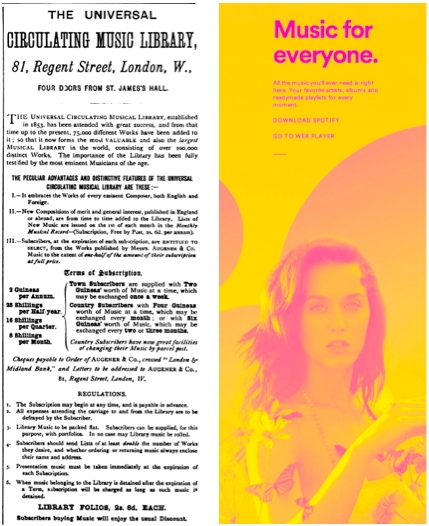
    Advertising music subscription services in 1895 and 2015

    The first known musical lending library opened 250 years ago in Paris. A Belgian painter named Antoine de Peters spearheaded the venture, calling it the Office of Music Subscription (Bureau d’abonnement musical) and modeling it on literary lending libraries. “Since music has become an almost general amusement,” read Peters’ July, 1765 newspaper advertisement, “nothing is more useful than a shop that has assembled all kinds of music from ancient to modern. Such is on offer at the business we are announcing today that will be opened the 22nd of this month…The subscription will be 24 livres per year, in exchange for which sum the subscriber can take whatever piece of music that they would like.” The library would have a large selection of instrumental and vocal music, with new pieces being added daily. Subscribers would receive a catalog updated every six months with the latest holdings, and could borrow the music of their choice for up to eight days at a time, checking out a new score each time they returned the previous one in good condition. Peters assured that “this establishment, which is run by people of taste, will contribute to the progress of art and will give the subscriber the pleasure of a varied repertoire.”

    He was promptly sued. Peters’ library included several pieces he had purchased from the publishing firm of Louis Balthazard de La Chevardière, and La Chevardière saw a threat to his business. “If the rental of music was preserved,” La Chevardière argued, “one would not sell any more music, and authors would increasingly neither compose nor engrave their music, in the belief that they would lose their expenses, since they could not sell.” La Chevardière recruited a number of musicians and publishers to join him in petitioning the court to confiscate the prints Peters was lending to subscribers in violation of their rights, and further to close his lending business altogether. Peters argued that his lending business in fact “facilitated the knowledge and purchase of music,” and was “necessary…for the multiplication of sales, the reputation of musicians, and the reward of their talents.” To prove the strength of his convictions, Peters proposed to – and did – engrave music at his own expense, both to lend through his subscription service and to sell. Peters was ultimately allowed to continue his subscription business. He also – thanks to his entry into printing – adjusted his business model. In 1767, he advertised two subscription options: the borrowing option at 24 livres/year, and a new ownership option, which for 60 livres/year got one two dozen works of new music to keep.

    By 1800, there were music subscription options in major cities across Europe. When Johann Karl Friedrich Rellstab opened a music lending business in Berlin in 1783, at the price point of 5 thaler per year, both the concerns of music publishers and the benefits for music consumers were familiar matters. “As far as the renting of music is concerned,” remarked an author in the Magazin der Musik, “I admit that I not only believe that it furthers musical enjoyment, but also that it would not hurt music publishers if they were to make less difficulty [for lenders] than is their wont. True, some borrowers rent in order to have parts of scores copied for themselves. It would be foolish to try to prevent such practices.” Like Peters, Rellstab also published and sold music.

    Throughout the nineteenth century, music-lending continued to go together with music-publishing: the proprietors of rental libraries were often publishers who paid composers for individual works upfront, based on the number of copies they expected to sell. Publisher-seller-lenders also continued to tweak their business models. In 1825, the Parisian music publisher Maurice Schlesinger advertised what he described as “a different kind of rental library in which, in exchange for committing themselves to purchasing 40 francs worth of music per year, people can take out music, try it as long as they like, and return it in exchange for something else if they do not want to keep it.” In 1840, he tried yet another model, this one a two-tiered system reminiscent of Peters’. For 30 francs/year one got a basic borrowers’ subscription. For 50 francs/year, one could keep up to 75 francs-worth of the music one borrowed. Schlesinger exited the music business shortly thereafter, however, his financial situation shaky in part because musicians felt he treated them unfairly (Franz Liszt called him a “stupid scoundrel”). Meanwhile, music publisher-seller-lender Alexandre Grus found subscription services to be his main area of growth, claiming in 1845 that his shop in Paris had “enjoyed a large expansion by its sales in France and abroad, but especially by its music lending service, one of the most complete in this field.”

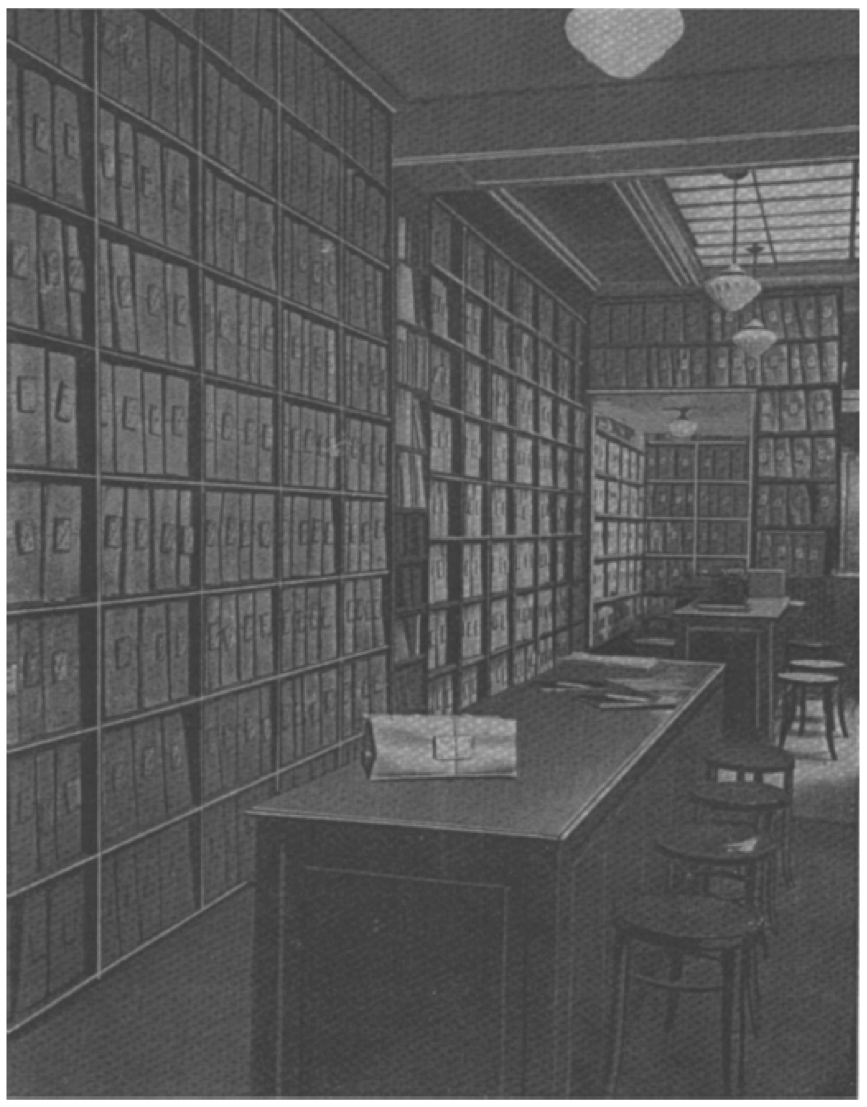
    one of several reading rooms dedicated to subscription services at Fortin Music Lending Library in Paris,  pictured in catalog, 1933
    one of several reading rooms dedicated to subscription services at G. Fortin’s music shop in Paris (pictured in catalog, 1933)

    Yet even as subscription services became an established part of the musical landscape, they continued to generate controversy – not only for their impact on music sales but also, increasingly, for their impact on people’s relationship to music. A critic writing for the Allgemeine musikalische Zeitung in 1833 lamented that, “the love of musical art has increased considerably all over…and yet music sales are no greater.” He attributed a “decrease in the sale of musical works” to “the increased lending libraries that have penetrated even in smaller cities. With few copies a lot of people are entertained.” He related the rise of lending libraries in turn to “the type of prevailing enjoyment. One enjoys superficially, one always wants something new. If one has at all heard a work a couple times, so it’s enough: there are waiting ten new ones that also want to be tasted.” Hazell Cills found precisely such consumption habits among those she interviewed for an article on the shift from music ownership to streaming services. “In a few months,” an Rdio subscriber observed, “I’ll forget I even listened to it. I’m always looking for new music, period.”

    In the nineteenth century, critics used culinary metaphors to contrast – in clearly value-laden terms – the modes of consumption associated with music ownership vs. access. In 1887, the German piano teacher Aloys Hennes complained that “music lending libraries could very well be called ‘music snacking libraries.’” For Hennes, ownership was a prerequisite for deep musical engagement: “whoever is forced to purchase his notes as property, will firstly give far more thought to what is appropriate for him, and secondly, will thoroughly work through them before he proceeds to a new purchase of notes. Unfortunately, however, ‘music snacking’ has… for some, more charm than the inner penetration and mental grasp of a composition.” One hears echoes of Hennes in Questlove’s musings on streaming services: “it’s harder and harder to truly fall in love with a song or album. What was your cost of entry? How hard did you have to work?”

    But lending libraries also served those dedicated to deep musical engagement. Eduard Hanslick – a Viennese music critic, aesthetician and historian best remembered today for declaring the content of music to be “tonally moving forms” – turned to lending libraries for sustenance rather than snacks: “I was indefatigable to get to know new music…As a subscriber to this loan service I renewed almost daily my musical nourishment and had to take a lot of kidding that I was never seen on the street without the music bag under my arm.” Hanslick commended the J. Hoffmann library to which he subscribed not only for its quantity of music but more importantly for the quality of its printed catalogues. Without such tools to inform listeners about what was in the collection, a music library did not truly offer access – and as holdings ballooned (C. A. Klemm music library in Leipzig went from 8,000 titles in 1821 to 57,000 titles in 1891), managing the information side for subscribers posed a mounting challenge.

    The number of musical lending libraries peaked between 1850 and 1880. By 1925 they had largely disappeared, finally going extinct around 1950. Recorded music would seem an obvious killer of demand for sheet music, but the decline of music lending libraries in fact precedes the rise of recordings, and researchers have identified changes in print itself as a more significant factor. In the late nineteenth century, the cost of music printing declined while disposable incomes rose, fueling a shift to music ownership. The concomitant explosion of new music titles further hurt lending libraries, which found it increasingly difficult to keep their stock and catalogs up to date.

    apple-maiden-data-center-4
    one of many data centers to support Apple’s subscription music-streaming service

    The idea of the music lending library vanished so completely that today, subscription services are framed as a new experiment rather than as a continuation or revival of a traditional part of the music business. We stand to gain from awareness of the 250-year history of music subscription services, not inner peace with the model now being so monolithically pushed, but rather a healthier skepticism toward claims that any model represents “the” answer for the music industry. From their introduction in the eighteenth century, music subscription services worked both together and at cross purposes with music ownership. They were one piece of a diverse marketplace in which consumers enjoyed music, and musicians and middlemen made (and lost) money. And just as we’re reinventing this particular piece of the music business for our digital age, so have we been reinventing others. Crowdfunding, for instance. But that’s another story.