Category: Music Tomorrow

  • Everything New is Old Again: Minna Choi, Kapellmeister for the 21st Century

    There has of late been much hand-wringing over the future of the orchestra.  And for good reason.  Orchestras are filing for bankruptcy left and right – and not just mid-level orchestras like Syracuse and Honolulu, but top-tier orchestras like Philadelphia.  In recent months, WQXR asked five experts to address the question, “Are American orchestras are an endangered species?”  Joseph Swenson told The New York Times, “huge institutional orchestras are like imperialist armies that have over-extended themselves.” And Norman Lebrecht at the British magazine Standpoint declared a crisis of global proportions: “Realists are demanding to know exactly what a city of six million wrestling with post-industrial decline gains from having a costly and cumbersome musical pantechnicon.  Who needs a symphony orchestra?  That’s what they are asking, the world over.”

    For every doomsayer predicting the extinction of the orchestra in this discussion, there is an optimist declaring the orchestra immortal as the jellyfish.  In the above mentioned WQXR video, Raymond Hair cites data that Americans continue to spend money on the performing arts, and concludes that the survival of the orchestra as we know it simply requires better management.  According to Norman Lebrecht at Standpoint, we need orchestras now more than ever because “the symphony orchestra is our relief from the communicative addiction”:

    the symphony orchestra will always survive — not on the weary old argument that it is somehow “good for you” to listen to “good music”, nor on any cod theories that classical music breeds clever kids and better citizens, but simply because there is a cogent human need for what an orchestra adds to the relief of city life. That need becomes ever clearer as the world speeds up.

    Sounds good.

    Except for the reality that the symphony orchestra as we know it is an institution of the industrial age, and we are living in an information age.  The former prized monumentality at any cost, fidelity to the self-expression of the artistic genius, and the eternal perfection of the work of art; the latter prizes efficiency, sustainability, interactivity and the particularity of now.

    Which is why the future of the orchestra may look something like this:
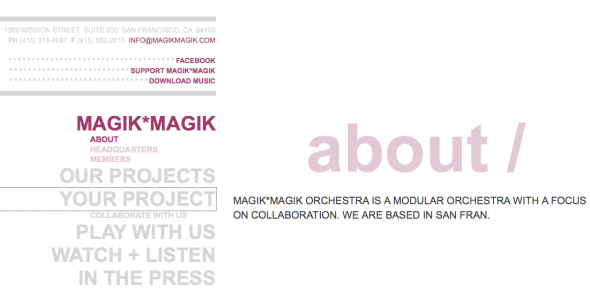
    The Magik*Magik Orchestra, as their website says, “is a modular orchestra with a focus on collaboration.”  By modular, they mean that they play in any configuration, from a soloist or string quartet up to their full roster of 60+ musicians.  By a focus on collaboration, they mean that they play primarily with (rock) artists seeking instrumentalists for their recording or performance projects.  And by orchestra, they mean what you would expect: an organization of conservatory-trained musicians on classical Western instruments, who play together under the direction of a conductor – in this case Minna Choi, also the orchestra’s founder.

    Here’s a sample of the Magik*Magik Orchestra in action, in concert with the Dodos (please forgive the sound quality):

    Now, before you dismiss Magik*Magik as a back-up pops orchestra, not a real orchestra, consider Minna Choi’s response to an interviewer at The Bay Bridged, who asked “What do you think separates Magik*Magik from other orchestras, musically or culturally, or in terms of the organization’s aesthetic?”  Situating her orchestra in relation to the type of orchestras now declaring bankruptcy, Choi replied:

    Most orchestras today exist as stand-alone entities. They perform season concerts, and sometimes have guest artists come in to play with them, but almost everything they do is just the orchestra. Magik, however, is almost entirely collaborative, so we’re always supporting or playing with a band, we rarely perform just by ourselves. Also, it’s one of our goals to be as accessible to everyone as we can, and I think that people see us that way–a band who has never worked with orchestra players before can come to Magik and get an arrangement written for their song, and an awesome group of players to track the song.

    Magik*Magik is now the “orchestra in residence” at Tiny Telephone, a studio frequented by indie rock artists for whom Choi writes chamber/orchestral arrangements to order, and leads her musicians on demand.  This indeed sounds nothing like the orchestra of the industrial age, with its regular schedules and timeless works.  But it sounds quite a bit like the orchestra of another age – the one we call the Age of Enlightenment.

    In the eighteenth century, composers and musicians were employed by courts or churches to provide music on demand, whether the occasion be a religious service, a political ceremony, or a social entertainment.  The composer who wrote the music for the occasion also directed the performance – he was in charge of the musicians and responsible for satisfying the musical needs of his employers.  Such a director was called a Kapellmeister, and it was as Kapellmeister that Bach composed his Brandenburg Concertos, and Haydn his Farewell Symphony (to give just two examples that, by later standards, transcended their immediate purpose) .

    Minna Choi is the Kapellmeister for the 21st-century.

    In the late eighteenth century, the court orchestra went into decline.  This decline resulted from the same factors that enabled the birth of the orchestra as an independent, public institution (namely, industrialization and the rise of the middle class).  Just as Haydn’s princely employer dismissed the staff of musicians from the court at Esterháza, a musical entrepreneur contracted Haydn to present new symphonies in public concerts in London.  Court patronage and ticket-purchasing public – at the end of the eighteenth century, the latter replaced the former as the economic foundation of the orchestra.  Now the pendulum swings back to patronage, with the difference that indie rock artists, rather than royality, are the patrons.

    By being the Orchestra of the Information Age, Magik*Magik revives a long dormant tradition of orchestral music made to order, on demand, for the moment.  Whether this model will take over from the symphony orchestra as we have known it for the last century, will coexist with that orchestra, or will remain a unique experiment remains to be seen.  But to use Joseph Swenson’s words, the Magik*Magik Orchestra suggests one way that “the new modern symphony orchestra will once again be a living, breathing, flexible and curious organism.”

    The Orchestra of the Future?

  • Word of the Day: Zankelfication

    Zankelfication, noun /zæŋk(ə)lfəˈkeɪʃ(ə)n/

    etymology: derived from Zankel Hall, the underground multimedia-friendly recital space at Carnegie Hall that programs classical, jazz, world, and pop music; coined by Zachery Woolf in a December 2, 2010 Capital New York article on cellist Maya Beiser

    definition: 1) the incorporation of new values, elements or practices into a tradition – particularly a tradition considered moribund or in need of popularization – so as simultaneously to revitalize and threaten that tradition; 2) hybridization; 3) spectacularization; 4) “cross-over” driven by artistic rather than marketing concerns

    The group [Eighth Blackbird] was founded 15 years ago with the goal of focusing on a relatively small repertory, with theatrically charged performances and memorized music. (The Zankelfication of classical music in action). (Capital New York, Feb 18, 2011)

    back formation: zankelfy (verb)

    Zoe Keating zankelfies Beethoven.

  • It Sounded Like the Future

    It sounded like the future,” begins a review of a recent installment in the Wordless Music concert series: a future in which classical music and indie rock occupy not opposite sides of a cultural divide, but rather the very same musical space.  Ronen Givony founded the Wordless Music series in 2007, and as he explains in the mission statement on the Wordless Music website:

    Wordless Music is devoted to the idea that the sound worlds of classical and contemporary instrumental music — in genres such as indie rock and electronica — share more in common than conventional thinking might suggest. To illustrate the continuity between these worlds, the series pairs rock and electronic musicians in an intimate concert setting with more traditionally understood classical music performers. The goal: to bring audiences together, and to introduce listeners from both worlds to composers that they might otherwise not encounter, for a completely new concert experience. In so doing, Wordless Music seeks to demonstrate that the various boundaries and genre distinctions segregating music today — popular and classical; uptown and downtown; high art and low — are artificial constructions in need of dismantling.

    The artificiality of the boundary between popular and classical music was brought home to Givony when he asked a co-worker at Lincoln Center what differentiated an intimate instrumental performance at the Mercury Lounge from the chamber music concerts their institution promoted.  In Episode One of a 2008 radio series on Wordless Music, Givony recounted his co-worker’s answer:

    As a definition of classical chamber music, silent audiences certainly seems inadequate.  Few would say that playing Brahms for noisy audiences at a bar or cafe, as musicians of Classical Revolution have been doing since 2006, transforms the music from classical into popular fair.  On the contrary, the idea that under any performance circumstances a certain canon of music remains classical – with all the social, aesthetic, intellectual and spiritual values attached to that category – underlies the project of bringing it into less formal, more popular venues.  Those hoping to increase appreciation of classical music by this means often invoke history to justify listening to classical music not with the attention and reverence associated with the recital hall, but with the informality, sociability and pleasure associated with popular music.  In the same radio episode mentioned above, for example, composer David Lang told host Jad Adumrad:

    Wordless Music, however, seems to be aimed in the opposite direction.  Instead of bringing classical music into bars and cafes, Wordless Music brings indie rock and electronica into recital halls and churches, programming it alongside works from the classical canon.  Givony describes this as an effort to “take indie rock a little bit out of its own ghetto and put it in a flower vase and see how it grows.”  The result has been some confusion: while seats or church pews seemed to say “sit still and be quiet,” the music – and sometimes the musicians – said “stand up, dance and shout.”  Here’s Do Make Say Think from WNYC Wordless Music Series Episode One:

    And Beirut, from Episode Three:

    These musicians smashed the vase Givony put them in – a good thing since flowers don’t grow in vases: they slowly wilt and die.  But the Wordless Music series has been quite effective at taking classical music out of its vase and planting it in ground where it can grow.  The most recent Wordless Music concert was weighted towards the classical, with orchestral and chamber works by Philip Glass, Ligeti and (rock representative) Jonny Greenwood.  There was no dancing or shouting to these works.  But there was enthusiastic clapping between movements.  And that, in a small way, sounds like the future.

    Recommend listening: the Wordless Music Series on WNYC in its entirety.

  • Why a blog? Why now?

    A couple weeks ago, Alex Ross published a piece on the New World Symphony’s new home, the New World Center in Miama.  The Frank Gehry-designed building is a spectacular statement on what it means to be a 21st-century symphony orchestra.  Together with neighboring Soundscape Park, the new facility enables WallCasts – projections of concerts taking place inside the hall onto a 7,000 sq. ft. wall outside, with sound delivered through 167 speakers – that look and sound amazing, and make concerts accessible to a wider (more sociable, less reverent) audience.  But what really got my attention was Ross’s observation that the concert hall “is explicitly designed as much for the projection of images as for the projection of sound. The fusion of film and live music is so mesmerizingly seamless that I felt I was witnessing not just a technological forward leap but the emergence of a new genre.”

    The combination of sight and sound in musical experience, and the use of technology to alter their combination, are particular interests of mine.  As I’m presently completing my dissertation on music and optical technologies of the late eighteenth and early nineteenth centuries, I spend a lot of time thinking about “old media” like magic lanterns and shadow-plays.  But in the days following Ross’s article, I found myself reading about new 3-D projection technology developed for Robert Lepage’s Siegfried at the Met next season; an article on the International Music Scores Library Project led me to one I had missed on the Borromeo Quartet’s use of laptops in place of printed parts (though it’s the projection screen that has me most intrigued); and an article on Hahn-Bin had me unexpectedly in the Fashion & Style (as opposed to Music) section of the NYT, with the Juilliard-trained violinist declaring “how I choose to express myself visually is equally important as the music itself.”

    These articles were in the back of my mind when, two days ago, I attended a talk by Dan Cohen on The Ivory Tower and the Open Web.  His talk had numerous tweetable moments, but I was particularly struck by his comparison of the “academic way” and the “web way,” the former being to refine and polish one’s work to perfection before letting it out into the world (in the form of print), the latter being to experiment and iterate, allowing for continued dialogue and change.  As a writer, I have a lot of “academic way” in my life.  I could use a little “web way.”

    Hence this blog: a space where I can collect musical/technological/cultural phenomena of interest to me, and do some thinking out loud.  We’ll see what it turns into – as is the web way.

    So, what do I make of the New World Symphony, the Borromeo Quartet, and Hahn-Bin?  One take in broad strokes: the nineteenth-century embraced the Romantic, (seemingly) anti-visual practice of listening with eyes closed.  In the twentieth century, radio and recording technologies fostered the idea of musical listening as a purely auditory experience.  Now, amid proliferating audiovisual devices, the visual has reasserted itself as constitutive of musical experience: we have entered an age of listening with eyes open, and the classical music world is learning to adapt.  In this phase of experimentation, we can experience again and again the pleasure of the unprecedented – like the “emergence of a new genre” Ross felt he was witnessing at the New World Center, and the “I’ve never seen/heard anything like it” reactions elicited by Hahn-Bin.  But while much is new, we are also witnessing revivals of largely forgotten, previously outmoded forms.  The description of what the 3-D technology at the Met will do, for example, recalls Pepper’s Ghost of the late nineteenth century.  The competing claims of the old and the new will, I expect, be one of the themes of this blog, as will classical music’s ongoing competition for our eyes and our ears.