Category: Music and Technology

  • The Reason for the Teardrops on My Guitar

    Yesterday The Washington Post published “Why My Guitar Gently Weeps,” an interesting story on the electric guitar that looks at the pervasiveness of guitar culture in the 60s-80s, the decline that started with the introduction of drum machines and continues today with laptop-based music production, and how the guitar industry is dealing with the dwindling market for their signature instrument.

    The article is subtitled “the slow, secret death of the six-string electric,” and cites real evidence that things aren’t what they used to be. But it also contradicts its own narrative. Or rather, it would contradict its own narrative if it recognized something simple: girl guitarists count too.

    Instead, the article opens with a guitar dealer’s plea, “what we need is guitar heroes,” and proceeds to discuss guitar heroes as creatures of the past. Having established the non-existence of present-day guitar heroes, the article ends with a revelation: Taylor Swift has been inspiring girls to learn guitar. According to Philip McKnight, who ran a guitar academy in Arizona, the percentage of female students at his academy went from below 10% before 2010 to around 60% after 2012. Taylor Swift was the number one reason these girls gave for picking up the guitar.

    Rather than see in this phenomenon the makings of a come-back story, or at least a ray of hope for the electric guitar, however, the finding is belittled. Fender CEO Andy Mooney is quoted as the authoritative word: “I don’t think that young girls looked at Taylor and said, ‘I’m really impressed by the way she plays G major arpeggios. They liked how she looked, and they wanted to emulate her.’” The “death of the electric guitar” narrative is allowed to stand, even though it’s now been shown really to be a story of fewer boys inspired by Eric Clapton or Eddie Van Halen (who, the assumption seems to be, are in it for authentic reasons of the music as opposed to mere looks).

    Rather than let Mooney’s dismissive comment stand, the author might have spent more time with McKnight. For something McKnight has also pointed out – but that goes unmentioned in the Post article – is that while there are more girls playing electric guitar, they are ill-served by the guitar industry. As he explains in this video:

    we noticed that we didn’t have any products for them. And what we really noticed is this industry has a strange kind of philosophy called shrink it and pink it. In other words they take every guitar and they just make it smaller and pink…and then they go, ‘that’s for a girl!’ which is stupid….but the more important thing is that, they’re not even acknowledging that girls really are the same guitar players they just maybe have slightly different tastes.

    “Why My Guitar Gently Weeps,” unfortunately, confirms McKnight’s assessment: there is still a failure to recognize girls as equally valid and valuable guitar players, who maybe have different tastes. Likewise, with a few notable exceptions – like the ergonomically-friendly St. Vincent signature guitar from Ernie Ball – little progress has been made in the way of product development. So it seems the guitar world, and especially the electric guitar industry still have opportunities to learn – and with that, maybe also to grow.

    Read more about the significance of women in the history of the electric guitar at Play Like a Girl, by Alicia Borromeo.

  • Audiovisual Returns

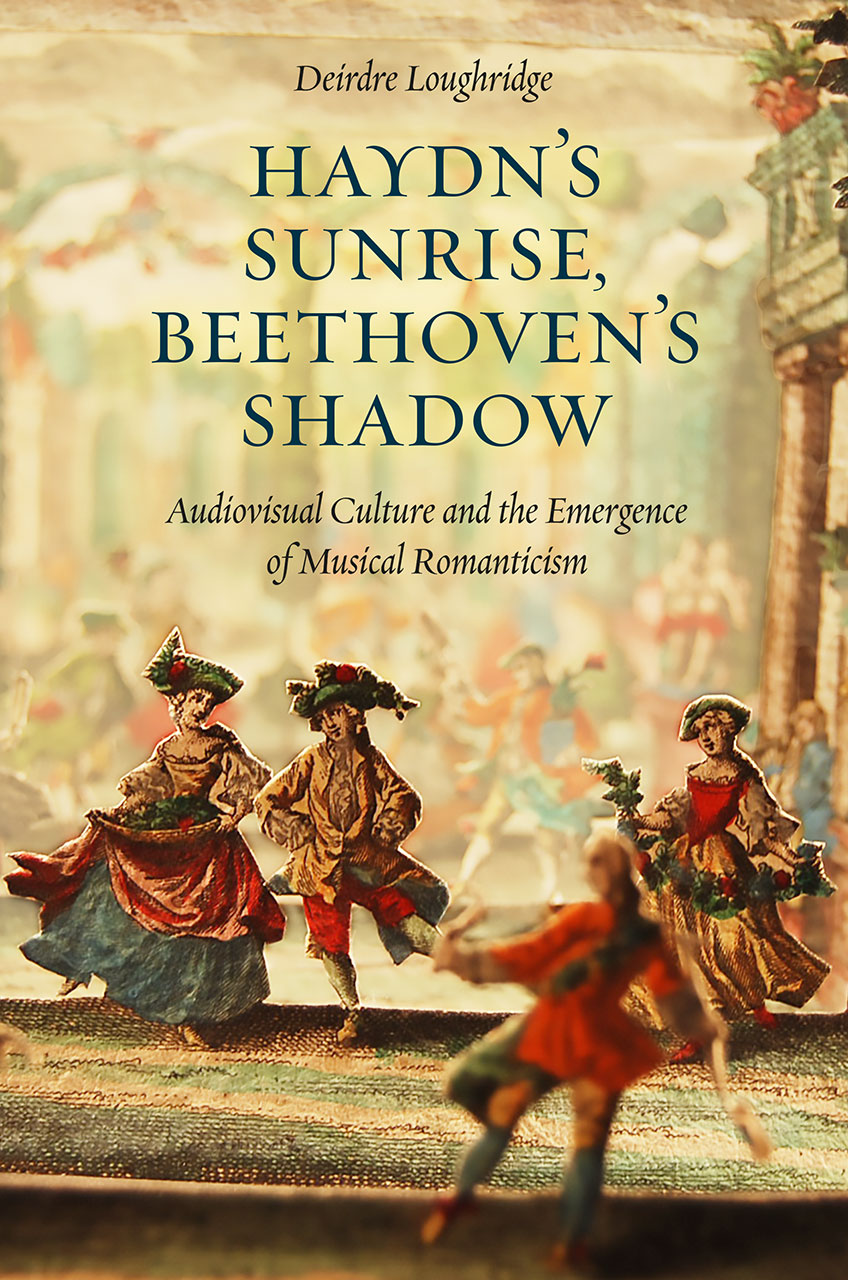
    An excerpt from my book, Haydn’s Sunrise, Beethoven’s Shadow: Audiovisual Culture and the Emergence of Musical Romanticism (University of Chicago Press, 2016), has been published at the blog Musicology Now. You can read it here: http://musicologynow.ams-net.org/2016/10/audiovisual-returns.html

    image-for-musicology-now
    eighteenth-century audiovisual culture (clockwise from top left): peepshow, magic lantern show, shadow-play, phantasmagoria
  • Haydn’s Sunrise, Beethoven’s Shadow: Book Out Now

    Haydn’s Sunrise, Beethoven’s Shadow: Book Out Now

    One critic, writing around 1800, had this to say about Haydn’s oratorio The Creation:

    “what can aesthetics have to say to a natural history, or geogony, set to music, where the objects pass before us as in a magic lantern?”

    The remark made me to wonder: what is a magic lantern? And why was it so bad for a musical work to be like one?

    So began the research journey that has led to the publication of my book, Haydn’s Sunrise, Beethoven’s Shadow: Audiovisual Culture and the Emergence of Musical Romanticism, out now from University of Chicago Press (also available from the usual suspects). In it, you can find out what a magic lantern is (an early form of slide projector), why it was so bad for a musical work to be like one – but also how the links people forged between music and moving-image technologies in the time of Haydn and Beethoven fostered new ways of performing, listening to and thinking about music. As it turns out, there was a vibrant culture of peep and screen media in the eighteenth century that both involved music and informed musical experiences even when the technologies themselves were not present on stage. Beyond magic lanterns, there were telescopes, microscopes, peepshows, shadow-plays and phantasmagorias, which found their way into operas, salons, scientific entertainments and – as in the case of the quote above – the very ways people perceived and described music.

    I hope you’ll check it out!

  • Imaginary Mechanical Instruments

    Imaginary Mechanical Instruments

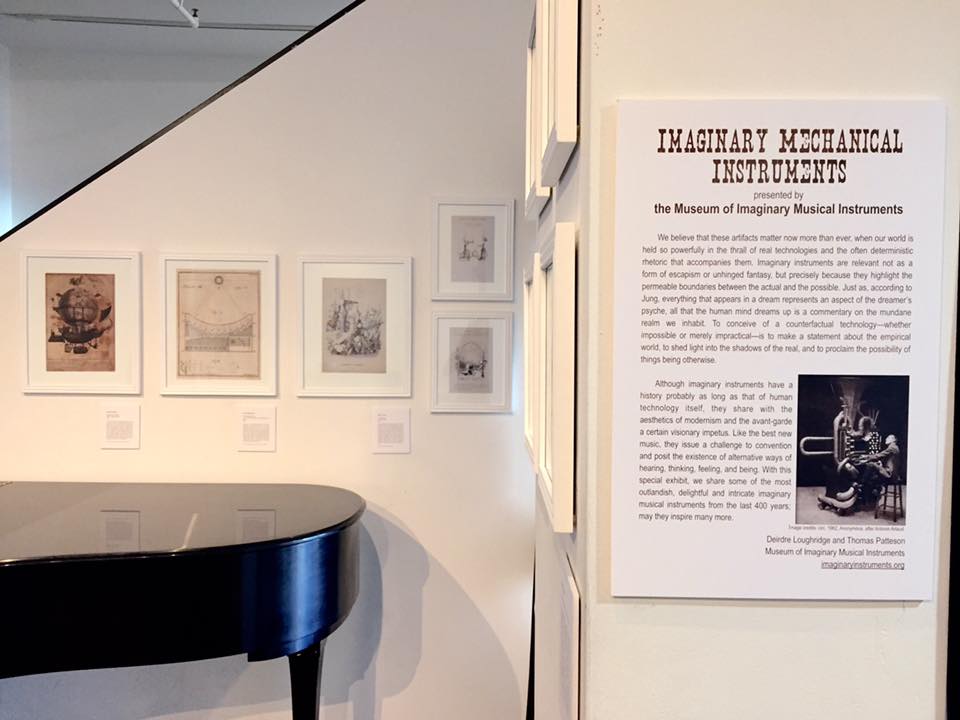
    A glimpse of a real live exhibit of imaginary mechanical instruments at the Center for New Music in San Francisco:

    imaginary-mechanical-instruments-cnm

    A note on the show from your curators, Deirdre Loughridge and Thomas Patteson:

    In a time of unprecedented activity and innovation in sound technology, a museum of imaginary musical instruments may seem unbearably twee. What could these phantasms have to do with the real instrumentarium that expands dizzyingly around us every day?

    We believe that these artifacts matter now more than ever, when our world is held so powerfully in the thrall of real technologies and the often deterministic rhetoric that accompanies them. Imaginary instruments are relevant not as a form of escapism or unhinged fantasy, but precisely because they highlight the permeable boundaries between the actual and the possible. Just as, according to Jung, everything that appears in a dream represents an aspect of the dreamer’s psyche, all that the human mind dreams up is a commentary on the mundane realm we inhabit. To conceive of a counterfactual technology—whether impossible or merely impractical—is to make a statement about the empirical world, to shed light into the shadows of the real, and to proclaim the possibility of things being otherwise.

    Although imaginary instruments have a history probably as long as that of human technology itself, they share with the aesthetics of modernism and the avant-garde a certain visionary impetus. Like the best new music, they issue a challenge to convention and posit the existence of alternative ways of hearing, thinking, feeling, and being. With this special exhibit, we share some of the most outlandish, delightful and intricate imaginary musical instruments from the last 400 years; may they inspire many more.

    July, 2016

    Head on over to the Center for New Music in San Francisco to see “Imaginary Mechanical Instruments.” Go Friday, Aug 26 at 7pm to enjoy a free reception. Visit the Museum of Imaginary Musical Instruments anytime to see more fantastic, counterfactual musical inventions.