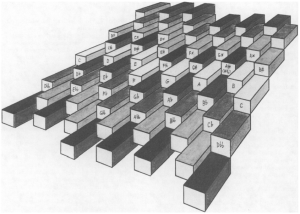
Ranging from the physically impossible to the simply impractical, from the “never” to the “not yet,” imaginary instruments rattle suggestively at the windowpane separating our comfortable sense of reality from that nebulous space beyond. In the words of Ernst Cassirer, such instruments are “concerned in the final analysis not with what is, but with what could be.”
As of today, the museum is open for visitors. Please wander about, check out some exhibits – we hope you find as much joy and wonder exploring its imaginary musical instruments as we have.
New technologies, as they begin to take hold, have always elicited fear and criticism of the changes they will bring. Such was the main message of two stories that passed through my Twitter feed last week. The first, by Tom Standage, was an op-ed piece in the New York Times on coffee houses as the new social networking platform of the 1600s. Standage recounts seventeenth-century worries that coffee houses were places of distractions that undermined productive work and mental concentration. Standage concludes:
There is always an adjustment period when new technologies appear. During this transitional phase, which can take several years, technologies are often criticized for disrupting existing ways of doing things. But the lesson of the coffeehouse is that modern fears about the dangers of social networking are overdone.
Rebekah Higgitt offered a follow-up in the Guardian, citing concerns dating back to the eighteenth century that technological innovations are speeding up the pace of life and endangering our well-being. “We were doomed (again),” she sums up: “There is nothing so old as warnings about modernity.”
These types of stories are valuable for demonstrating that technologies and social practices with which we feel comfortable – so comfortable we wouldn’t even think to question them – once were the subject of heated debate (I’ve told such a story myself for Auto-Tune). But these stories also do something concerning: they imply that our criticisms and concerns about new technologies will soon look just as silly as those of the past – that we can dismiss today’s fears because we’ve heard them all before. Framed this way, these stories use history to teach us to embrace the latest innovations, and to foreclose critical discussion of their effects and trade-offs.
The history of technological transitions has other lessons to offer, however. Let’s consider a musical case: the adoption of the valved horn.
The valved horn, familiar as the French horn, is now a standard member of the orchestra. But the valve mechanism employed in horns and other brass instruments was invented only in the 1810s (i.e. twenty years after Mozart’s death, and after Beethoven had composed most of his symphonies). Until then, all horns were made of coiled metal tubing without keys, and the length of this tubing determined the frequencies at which the the instrument would resonate. These frequencies were limited to the pitches of the harmonic series. In the key of C, these would be:
There were thus gaps between the available pitches, especially in the lower register. To get intermediate pitches required the technique of hand-stopping, which altered the tone of the instrument (though especially virtuosic horn-players were able to reduce the difference to near imperceptible).
Valves closed the gaps in the harmonic series, making it possible for horns to play the entire chromatic scale throughout their range. This would seem an obvious advantage – more notes, more musical possibilities. But like the coffee house, the valved horn prompted an abundance of worried commentary. The tone of the valved horn was considered inferior, the instrument lacked the singing quality of its predecessor, and horn players were losing the sensitivity and knowledge that came with learning to control the intonation and tone color of the valveless horn. As one critic wrote in 1837:
What are we to do with all the stories we hear about valves and keys? They ruin the natural characteristic tone and make it so that soon we will have only yellow and red, with which we can no longer fittingly paint and shade….
Another in 1835 wrote:
I want to attempt to discuss the disadvantages of the general introduction of the valved horn in some detail…Sadly one cannot mistake the Zeitgeist in the introduction of this instrument…should we then keep no instrument that is actually created totally for singing?
And in 1865:
But in the future how would orchestral music (with string instruments) fare, if the good players of the natural horn became increasingly scarce?…a skilled horn player can be trained only if he uses the natural horn in his practice….Thus the worst decline threatens…
We might now chuckle at those who worried about the valved horn, and look upon those who fear the consequences of digital technologies for music as equally overdrawn in their concern. But the choice of valveless or valved horn was a matter of trade-offs – each was better for certain purposes, as this concert reviewer recognized in 1842:
It is undeniable that the natural tones of the natural horn far surpass the natural tones of the valved horn in fullness and tone quality, yet on the other hand, there is a perfect equality of all the whole and half steps on the valved horn that makes it possible to work in all scales with nearly equal success
The transition to the valved horn was thus not a matter of the inferior giving way to the superior, but of certain values – and certain people – winning out over others. The winners in this transition included those who patented valve technologies. The obvious losers were valveless-horn players, whose skills and knowledge were rendered increasingly irrelevant. Though many nineteenth-century commentators maintained that both valved and valveless horns were valuable and necessary, each for their purpose, by the twentieth century valveless horn-players were wanted neither for performance nor teaching positions.
In terms of values, the transition to the valved horn was a matter of the chromatic scale winning out over resonance. Here, especially, we can learn from early criticisms of the new technology. For while critics may voice particular fears that in retrospect appear unjustified or narrow-minded, their worries can also reveal the particular interests upon which a new technology is based – and which, once the technology has been adopted, come to seem natural, inevitable, invisible. When a fourth-grader is handed a French horn, she is handed the privileging of pitch over other musical dimensions – a preference for thinking about music as a matter of relations between pitches rather than relations between sounds and physical bodies. While valves expanded the capabilities of the horn in certain senses, it also reduced the uniqueness of its musical voice and perspective. As one mid nineteenth-century critic of the valved horn’s tone observed, getting at the dynamics of accommodation and erasure at play in the transition to the valved horn: “it appears that one wants to make all instruments play like keyboards.”
After falling into almost complete disuse for the first half of the twentieth century, valveless horns were revived by the historically informed performance movement which found for it a new value: fidelity to the composer’s original conception of his musical works. One may now thus compare, say, a performance of Beethoven’s Pastoral Symphony using today’s valved horns with one using horns of the early nineteenth century. This revival of the valveless horn made possible another development: composers are now finding the unique musical potentials of the instrument suited to their expressive purposes. Ligeti’s Hamburg Concerto, completed in 2002, exploits the fact that valveless horns sound the overtone series native to their particular length. As Ligeti explains:
by providing each horn or group of horns with different fundamentals I was able to construct novel sound spectra from the resulting overtones. These harmonies, which had never been used before, sound “weird” in relation to harmonic spectra.
Musical values have shifted, making it clear that valved horns reflect one set of priorities – and that those who worried about the loss of valveless horns – their techniques and musical properties – were quite justified in doing so.
So yes, there is always an adjustment period when new technologies appear, and during the transitional phase technologies are often criticized for disrupting existing ways of doing things. But the lesson of the valved horn is that new technologies embed certain values and, once adopted, conceal alternatives – hence the retrospective bafflement at all that worry.
…whoever has spoken or whoever may speak into the mouthpiece of the phonograph, and whose words are recorded by it, has the assurance that his speech may be reproduced audibly in his own tones long after he himself has turned to dust. The possibility is simply startling…Speech has become, as it were, immortal.
“A Wonderful Invention – Speech Capable of Indefinite Repetition from Automatic Records,” Scientific American (Nov 17, 1877)
At the end of the nineteenth century, the invention of sound recording suggested a new era in which the voice would not die with the body but would rather be stored up, preserved, so that future generations could hear the dead speak. As one phonograph enthusiast remarked in 1896, ”death has lost some of its sting since we are able to forever retain the voices of the dead.”
But what if one wanted to hear a voice of the dead say something it had never uttered in life? That was the challenge faced by the creators of the Tupac Shakur “hologram” for the 2012 Coachella Valley Music and Arts Festival. Though the resurrection of Tupac (who died in 1996) proved a media sensation, reporting focused almost exclusively on the visual illusion and its mechanics – including a special fascination with the fact that the “hologram” wasn’t really a hologram but rather constituted a 21st-century version of a 19th-century optical illusion known as Pepper’s Ghost.
Tupac’s vocal performance, no less than his dance moves, required technology wizardry with a curious genealogy. The sound engineer responsible, Claudio Cueni, discussed the process of creating Tupac’s vocal performance on Pensado’s Place (a show for folks in the audio biz). While the visual team plumbed footage and medical records to recreate Tupac’s appearance in meticulous detail, Cueni combed recordings: no vocal double was be used – everything had to be Tupac’s own voice. The word “Coachella” – crucial to establishing the virtual Tupac’s presence at the festival and apparent interaction with the audience – proved particularly difficult, as Tupac never said the word in life (the Coachella music festival started in 1999, three years after Tupac’s death). But by joining the word “coach” to a mixture of sound-alikes for “ella,” and by time-stretching, auto-tuning, and altering vowel sounds with the audio plug-in Talkbox, Cueni was able to assemble the phrase “What the f*** is up Coachella?” from Tupac’s recorded voice.
It is with Talkbox that the genealogy of Tupac’s resurrected voice gets interesting. Since 2008, the plug-in has come with the digital audio workstation Pro Tools. In its Audio Plug-Ins Guide, Pro Tools explains that the purpose of Talkbox is “to add voice-like resonances to audio signals.” The website Pro Tools Production adds that this plug-in (like many plug-ins) digitally models a previous analog device:
The hardware equivalent is a stomp-box with a speaker connected to a plastic tube which ends up in the musician’s mouth. The user changes the shape of his/her mouth to filter the sound which is then picked up by a vocal mic.
The hardware predecessor to Talkbox was brought to prominence in the 1970s by Peter Frampton, who used it on such hits as “Show Me the Way” (from the album titled – get this – Frampton Comes Alive!).
Before there was the Talk Box, however, there was the Sonovox. The idea behind these two technologies was similar: both used the shape of the mouth to modify the frequency content of a reproduced sound. With the Sonovox, instead of putting one’s mouth on a tube that transmitted the sound to be modified, one pressed two loudspeakers against one’s throat. In both cases, the user silently mouths words while the transmitted sound does the job of the larynx, or voice box. (“The Talk Box is an extra larynx,” Frampton has said, “you shut of yours and get piped in larynx. It could be a guitar, it could be a synthesizer – anything that could be amplified and come out of the speaker and be bypassed and put through the tube.”) Lucille Ball demonstrated the newly invented Sonovox in a newsreel of 1939, in which the sound she modifies comes from a recording of a train (in 1941, the Sonovox was used to impart speech to a whistle and steam for the voice of the train in Disney’s Dumbo):
Like the illusion of Pepper’s Ghost, the Sonovox found an early application in conjuring the dead. In the 1940 film You’ll Find Out starring Boris Karloff and Peter Lorre, the Sonovox plays an important role in the performance of seances. The first seance scene features three visitors from the beyond, the first speaking through a trumpet, the second drawing a low, growling voice from unseen drums, and the third a wispy voice in the wind:
In this second seance scene, the trick behind these voices is discovered:
These inhuman voices of the dead are a far cry from the faithful recreation of Tupac’s stage voice sought and achieved by Cueni (and it’s worth noting here the convenient fact that Tupac’s stage voice was always already mediated by microphones and loudspeakers, allowing Cueni to mask imperfections by adding reverb and delay without these effects seeming unnatural). Analogously, a main appeal of Pepper’s Ghost was that the seemingly three-dimensional figure could pass through objects and people; holographic Tupac, by contrast, remained distant from his on-stage company – never revealing the insubstantiality of his form, and encouraging us to perceive him as a living presence.
John Durham Peters has observed that “two ruling ambitions in modern technology appear in the phonograph: the creation of artificial life and the conjuring of the dead” (Speaking into the Air, 161). While the conjuring of the dead seemed to fade in importance in the twentieth century, the ability now not just to replay but also to reanimate the archive of a life lived – to generate new performances from it – has renewed the ambition. With today’s technology, death is no obstacle to the comeback.
If conjuring the dead remains a ruling ambition, however, it is also significant how much that ambition has changed in the last century+. Early phonograph users imagined that the vibrations of a voice, preserved in tinfoil or wax, carried a person’s presence. Something of this remains in the insistence that the holographic Tupac use Tupac’s own voice. Yet, in using Talkbox, Cueni treated Tupac’s recorded voice as an audio signal that needed to be artificially imbued with “voice-like resonance.” Like a train whistle or guitar, Tupac’s voice (cut up and reassembled syllable by syllable) became the raw material to which sonic markers of sentience and life were added. The remarkable result of such technological gymnastics was the convincing illusion of Tupac’s resurrection. Whereas yesterday’s technologies shadowed forth a second, ghostly realm, today’s thoroughly blur the boundaries between presence and absence, animate and inanimate, life and death.
In You’ll FindOut, the sonovox pivots from this “yesterday” to “today.” In the final scene, Mr. Kayser – the one who discovered the trick behind the seance – presents a more wholesome, musical application for the Sonovox. Just before the start of this clip Mr. Kayser declares, “it gave me a whole new idea for a band number. We’re going to let our instruments speak for themselves!”:
I’ve been experimenting with using Prezi to map out developments in music and (primarily visual) technology. Though it’s a bit clunky to use in this way, I like the ability to include images and move between distant and close views, and I’m finding it useful for organizing information chronologically and conceptually.



 Deirdre Loughridge